

The 20-30 Video "Data Feedback" Loop: How to Turn Your First Month of Uploads into a Growth Roadmap
Key Takeaways
- 1
Your first 20-30 videos are not content — they are a controlled experiment that reveals exactly which topics, formats, and posting patterns your specific audience rewards.
- 2
Tracking hook rate (the percentage of viewers who watch past the first 30 seconds), retention curves, and click-through rate across this sample size gives you statistically meaningful signals you cannot get from 5 or 10 videos alone.
- 3
Longform videos consistently outperform shorts on engagement — use your 20-30 video window to test both formats and let the data tell you where to double down.
- 4
The feedback loop only closes when you act on the data: cut what underperforms, clone what works, and run your next batch as a refined second experiment.
Why 20-30 Videos? The Science Behind the Sample Size
Most creators treat their first uploads as finished products to be judged. The smartest creators treat them as data points in an ongoing experiment. The number 20-30 is not arbitrary — it is the minimum threshold at which patterns become statistically distinguishable from noise. With fewer than 20 videos, one outlier (a video that got shared by a large account, or one that tanked for a technical reason) can skew every average you calculate. With 30 or more data points, those outliers normalize, and real signal emerges.
This is the foundation of the 20-30 video data feedback loop: a deliberate, structured approach to treating your early upload history as a research sprint rather than a content treadmill. By the time you publish your 30th video, you should know your best-performing topic cluster, your optimal video length, the thumbnail style that drives the highest click-through rate (CTR — the percentage of people who click your video after seeing its thumbnail in their feed), and the posting window that captures your audience when they are most active.
The Four Metrics That Define Your Feedback Loop
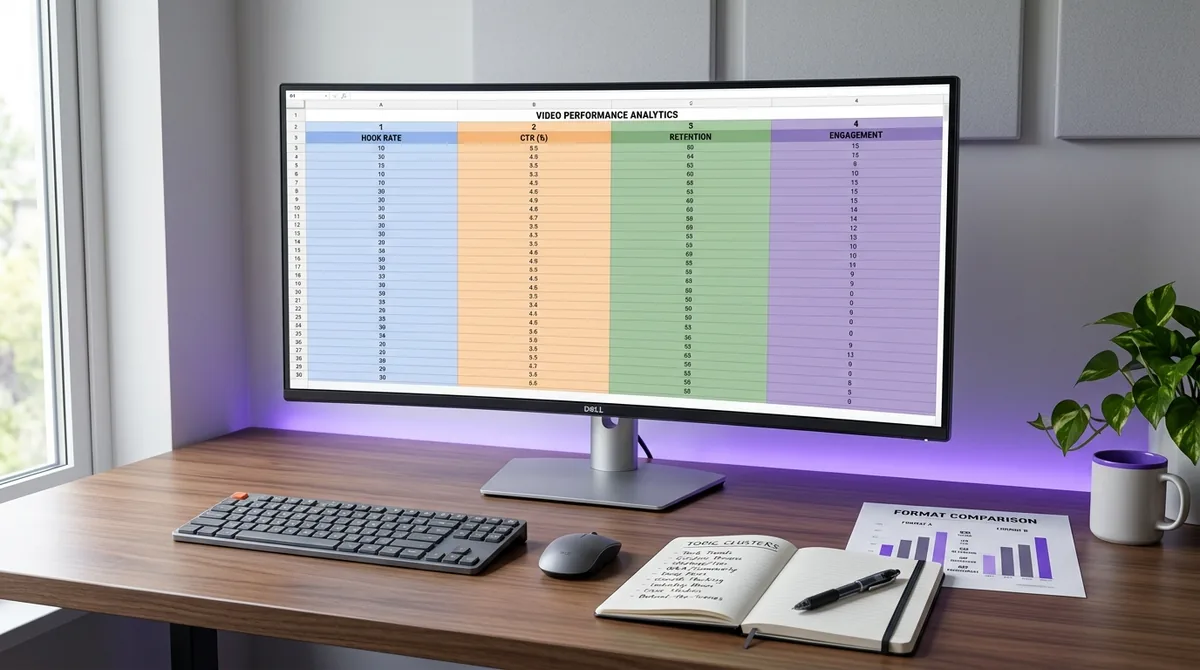
Before you can close the loop, you need to know which numbers to track. Four metrics do the heavy lifting during the 20-30 video sprint.
1. Hook Rate
Hook rate is the percentage of viewers who continue watching past the first 30 seconds of your video. It is the first filter the platform applies to your content. A video with a low hook rate signals to the algorithm that the opening failed to match the promise of the thumbnail and title — and distribution slows immediately. If you want to understand why this single metric has outsized consequences for your reach, the deep-dive at "Why Your YouTube Hook Rate Is Killing Your Reach" explains the mechanism in full. During your 20-30 video sprint, log the hook rate for every upload and look for the pattern: which video topics, opening styles, or thumbnail promises consistently hold viewers past that 30-second mark?
2. Average View Duration and Retention Curve
The retention curve is a graph showing the percentage of viewers still watching at each second of your video. A sharp drop at a specific timestamp tells you exactly where your pacing broke, where a segment ran too long, or where a topic pivot confused viewers. Across 20-30 videos, look for the timestamps where you consistently lose viewers — these are structural problems, not one-off bad days. Fix them in your next batch.
3. Click-Through Rate (CTR)
CTR measures how often viewers click your video when it appears as a thumbnail impression. A high CTR with low watch time means your thumbnail over-promises. A low CTR with high watch time means your thumbnail undersells strong content. The goal is calibration between the two. Across your 20-30 video sample, rank your thumbnails by CTR and study the visual and text patterns that separate your top five from your bottom five.
4. Engagement Rate
Engagement rate is the ratio of likes, comments, and shares to total views. It tells you which videos sparked a reaction strong enough to make viewers act. This is the metric most directly tied to community formation and long-term channel loyalty. For context on which metrics genuinely move channels forward versus which ones feel good but predict nothing, read "3 YouTube Metrics That Actually Matter (And 2 That Are Just Vanity)".
How to Structure the 20-30 Video Sprint
The feedback loop requires intentional variation, not random uploads. Structure your first 20-30 videos as a controlled experiment by deliberately varying one variable at a time across small batches.
Videos 1-10: Establish Your Baseline
Publish your best guess at ideal content — the topics you believe your target audience wants, in the format you are most comfortable producing. Do not experiment wildly yet. These videos establish a baseline average for all four metrics. At the end of video 10, calculate your mean hook rate, mean CTR, mean retention, and mean engagement rate. These numbers are your benchmark.
Videos 11-20: Test Format and Length
Based on AskLibra data from 4 connected channels and 511 videos analyzed, longform content generates an average engagement rate of 0.0226 compared to 0.0109 for short-form videos — more than double the engagement per view. This does not mean shorts have no role, but it does mean that if your baseline videos were all short, you are likely leaving significant engagement on the table. Use videos 11-20 to test a different length or format for the same core topics. Keep the topic constant and change the format variable. This isolates format as the cause of any performance change you observe.
Videos 21-30: Test Topic Clusters and Posting Timing
By video 21, you have format data. Now test topic variation within your niche. Group your video ideas into 3-4 topic clusters and publish 2-3 videos per cluster. Track which cluster produces the highest average engagement and retention. This is the beginning of topic authority — the process by which the algorithm associates your channel with a specific subject area and begins recommending your videos to viewers who have watched similar content elsewhere. For a detailed breakdown of how to organize your channel around topic clusters for algorithmic authority, see "Topic Clustering and Content Neighborhoods: How to Organize Your YouTube Channel for Algorithmic Authority".
Reading the Data: What Good Looks Like
After 20-30 videos, you should be able to answer five specific questions by looking at your spreadsheet or analytics dashboard:
1. Which 3 videos had the highest hook rate? Study their openings. What did they have in common — a direct question, a bold claim, a visual surprise? This is your hook template going forward. For a tactical breakdown of opening techniques that consistently stop the scroll, "Pattern Interrupt Hooks (2026 Edition): Stop the Scroll and Keep Viewers Watching" is the most current reference available.
2. Which 3 videos had the lowest retention drop-off? These are your best-paced videos. Reverse-engineer their structure — their segment length, their transition style, their use of recaps or previews.
3. Which topic cluster generated the most comments? Comments are a leading indicator of community. A topic that generates questions and debates is a topic your audience is emotionally invested in — and emotional investment is what the platform's sentiment-driven systems reward. The relationship between viewer emotion and algorithmic promotion is explored in detail at "Sentiment-Driven Algorithm Shifts: How Viewer Emotion Shapes What YouTube Promotes".
4. Which thumbnail style had the highest CTR? Face-forward thumbnails versus text-only, bright backgrounds versus dark, posed expressions versus candid — your data will tell you which visual language your specific audience responds to.
5. Did posting time correlate with performance? If your analytics show a consistent spike in views when you post at a particular hour, that is your confirmed posting window — not a guess.
Closing the Loop: Your Refined Second Experiment
The feedback loop only generates value when you act on its output. After video 30, you should retire or repurpose your three lowest-performing topic clusters, commit to the format that produced double-digit engagement gains, and build your next 20-30 videos as a second, more refined experiment — this time testing deeper variables like thumbnail text length, video chapter structure, or call-to-action placement.
This is not a one-time process. The most effective channels run continuous feedback loops, each one narrowing the margin of error between what they produce and what their audience rewards. Creators who want to move beyond reactive analysis into anticipating what their channel needs before problems appear should explore "Predictive Social Analytics: How to Use Data to See What Your YouTube Channel Needs Before It Happens".
The era of uploading and hoping is over. As "The Guessing Game Is Over: Why Creators Who Don't Use Data Are Leaving Money on the Table" makes plain, the channels that compound their growth are the ones that treat every upload as a measurable input, not just a piece of content.
Twenty to thirty videos. Four metrics. One structured sprint. That is all it takes to stop guessing and start building a channel on evidence.
Frequently Asked Questions
What if my first 30 videos all performed poorly — does the feedback loop still work?
Yes, and in some ways it works better. Uniformly low performance across 30 videos is clean signal: it tells you that the problem is systemic — likely your hook approach, your topic selection, or your thumbnail strategy — rather than isolated. You can identify the least-bad performers, study what separated them from the rest, and rebuild your next batch around those differentiators.
Do Shorts count toward the 20-30 video sample, or should I track them separately?
Track them separately. Shorts and longform videos operate on different distribution systems, different viewer intent, and different retention mechanics. Mixing them in one dataset creates averages that accurately describe neither format. Run parallel spreadsheets and analyze each format on its own merits before comparing them head-to-head.
How long should the 20-30 video sprint take in real time?
The sprint should take long enough that each video has had at least 14 days to accumulate views before you draw conclusions — most videos receive the bulk of their algorithmic distribution in the first two weeks. For a creator posting twice per week, 30 videos takes 15 weeks. For once-per-week creators, it takes 30 weeks. Resist the urge to accelerate by posting daily — quality control matters, and burning out before the loop closes defeats the purpose.
Which metric should I prioritize if I can only track one?
Hook rate. It is the earliest signal in the viewer journey and the metric most directly under your control through deliberate scripting and editing choices. A high hook rate gives the algorithm permission to distribute your video further, which then generates the view volume you need for all other metrics to become meaningful. Fix your hook first; everything else improves downstream.
Can I apply the data feedback loop to an existing channel, or is it only for new creators?
It applies to any channel at any stage. For established channels, select your most recent 20-30 videos as your sample set and run the same four-metric analysis. You may find that a format shift, a niche drift, or a thumbnail style change is responsible for a performance plateau — patterns that are invisible video-by-video but obvious when you look at 30 data points side by side.
Ready to see what the data says about your channel?
Stop guessing. Use AskLibra to get a personalized 90-day growth gameplan and find your perfect posting window.
Get Your Free Growth ScanNo credit card required • Join 2,000+ creators