

Growth Marketing vs. Performance Marketing: Which Wins?
Key Takeaways
- 1
Growth marketing focuses on the full customer lifecycle — from awareness to retention — while performance marketing zeroes in on measurable, paid conversions.
- 2
Neither discipline is universally better; the right choice depends on your business stage, budget, and whether you need long-term brand equity or immediate ROI.
- 3
The strongest marketing strategies borrow from both frameworks — using performance marketing to drive short-term results while growth marketing builds sustainable momentum.
Two Disciplines, One Budget, Which Actually Moves the Needle?
If you've ever tried to hire a marketer, brief an agency, or allocate a quarterly budget, you've probably hit the same wall: growth marketing and performance marketing sound like they should mean the same thing, but they don't, and confusing them is expensive. One discipline is built for speed; the other is built for scale. Knowing which one your brand actually needs right now is one of the highest-leverage decisions you can make.
What Is Performance Marketing?
Performance marketing is exactly what it sounds like: you pay for measurable outcomes. Every dollar spent is tied to a trackable action, a click, a lead, a purchase, a install. The dominant channels are paid search, paid social (Meta Ads, TikTok Ads, Google Ads), affiliate programs, and display retargeting.
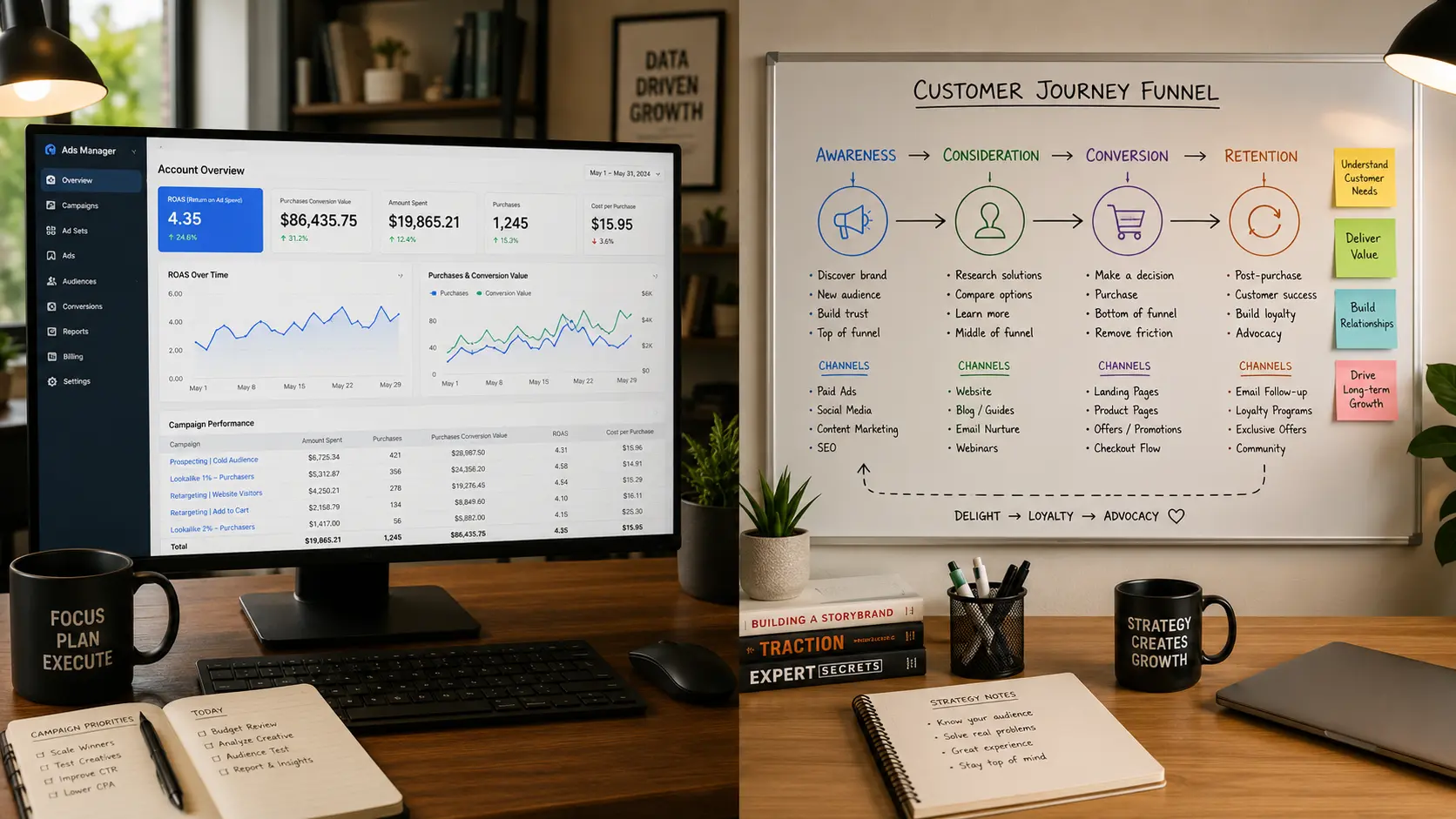
The defining characteristic of performance marketing is direct attribution. You know, or can reasonably calculate, what each conversion cost you. This makes it highly accountable and easy to justify to stakeholders who want to see return on ad spend (ROAS) in a spreadsheet.
Performance marketing is the discipline you reach for when you need results now. Launch a product, run a promotion, fill a sales pipeline, performance marketing is the accelerator pedal. The trade-off is that the moment you stop spending, the results typically stop with it.
What Is Growth Marketing?
Growth marketing operates on a longer time horizon and a wider canvas. Rather than optimising a single campaign funnel, growth marketing looks at the entire customer lifecycle, acquisition, activation, retention, referral, and revenue. You may recognise this as what's commonly called the AARRR framework, or Pirate Metrics, widely used in product-led and SaaS businesses.
Growth marketers run structured experiments across channels and touch-points. They're just as likely to be improving an onboarding email sequence or reducing churn as they are to be running paid ads. The work is cross-functional, touching product, data, content, and CRM, not just the ad account.
The defining characteristic of growth marketing is compounding returns. A/B tests that improve conversion rates keep paying dividends. Content that earns organic search traffic generates leads long after it's published. Referral loops, once activated, reduce your customer acquisition cost over time. Growth marketing is slower to show up in a weekly report, but it builds something performance spend alone never can: a machine that doesn't turn off when the budget does.
The Core Differences at a Glance
Time horizon: Performance marketing delivers fast; growth marketing compounds over months and years.
Scope: Performance marketing optimizes campaigns; growth marketing optimizes the entire customer journey.
Channels: Performance marketing lives primarily in paid media; growth marketing spans paid, organic, product, and lifecycle.
Measurement: Performance marketing measures ROAS, CPA, and CTR; growth marketing measures LTV, retention rate, NPS, and activation benchmarks.
Skill set: Performance marketers are specialists in platform mechanics and bid strategy; growth marketers are generalist experimenters with strong analytical instincts.
Which Is Actually Better for Your Brand?
Here's the honest verdict: neither is categorically better, but one is almost certainly more appropriate for where your business is right now.
If your brand is early-stage and needs to prove product-market fit or hit a near-term revenue target, performance marketing gives you the fastest feedback loop. You can test messaging, audiences, and offers in days, not months. The data you generate is also invaluable input for your eventual growth strategy.
If your brand has validated its core offer and is ready to scale sustainably, or if you're seeing diminishing returns from paid channels, growth marketing is the unlock. Investing in retention, referral, and organic acquisition reduces your dependence on ad spend and improves unit economics over time.
For most growing brands, the answer is a deliberate combination. Use performance marketing to generate cash flow and short-term acquisition data. Use growth marketing to build the infrastructure, content, lifecycle emails, onboarding, referral programs, that makes each acquired customer worth more and cheaper to retain. These two disciplines are not rivals. They're complements that work best when given clear lanes and shared data.
What This Means for Hiring and Budgeting
When building a team or briefing an agency, be specific about which mandate you're hiring for. A performance marketer who excels at Meta Ads is not automatically equipped to run a growth experimentation program, and vice versa. Misaligning the role with the expectation is one of the most common and costly hiring mistakes in marketing.
On the budget side, a practical starting point for scaling brands is to allocate the majority of paid media spend to performance channels for near-term returns, while reserving a meaningful portion for growth initiatives, content, CRO, email, and retention, that compound over time. The exact split depends on your margins, sales cycle, and growth stage, but the principle holds: don't fund only the channel that turns off when the money stops.
Frequently Asked Questions
Can a small business use growth marketing, or is it only for large companies?
Growth marketing is accessible at any business size, in fact, early-stage brands often benefit most because small improvements to retention or referral can dramatically change unit economics. You don't need a large team; you need a structured approach to testing and a willingness to look beyond the ad account.
Is SEO considered growth marketing or performance marketing?
SEO sits firmly in the growth marketing camp. It requires upfront investment with delayed returns, it compounds over time, and it reduces long-term acquisition costs, all hallmarks of the growth marketing discipline. Performance marketing prioritizes channels where spend directly and immediately controls output volume.
What metrics should I track if I'm running both strategies simultaneously?
Track performance marketing through ROAS, cost per acquisition (CPA), and click-through rate (CTR). Track growth marketing through customer lifetime value (LTV), retention rate, activation rate, and referral rate. Where possible, build a blended efficiency metric, like blended CAC versus LTV, that shows how both strategies are working together across the full funnel.
How do I know when to shift more budget from performance to growth marketing?
Watch for two signals: rising CAC on paid channels (a sign of audience saturation or increased competition) and stagnant or declining retention rates (a sign that acquisition is outpacing the ability to keep customers). When either trend appears, redirecting a portion of budget toward growth initiatives, lifecycle marketing, product onboarding, referral programs, typically improves overall efficiency.
Inspired by insights from Zaryn Sidhu. Adapted and expanded for the AskLibra audience.