

How to Win With AI in 2026: The Skill Stack Strategy
Key Takeaways
- 1
AI is not replacing skilled operators — it is amplifying the gap between those with strong foundational business skills and those without them.
- 2
A method called Skill Stacking positions you to use AI as a multiplier on expertise you already own, rather than chasing the tool itself.
- 3
Business owners who move now to pair human judgment with AI-assisted execution will hold a compounding advantage through 2026 and beyond.
The Operators Who Win With AI Are Not Who You Think
Most conversations about AI in business sound the same: automate this, replace that, prompt your way to profit. But the operators actually pulling ahead are not doing any of that. They are doing something quieter and far more durable.
They are stacking skills.
The premise is simple but easy to miss: AI does not create winners on its own. It amplifies whoever is holding it. Hand a weak strategy to an AI tool and you get weak output faster. Hand a sharp, experienced operator the same tool and you get a compounding advantage that compounds further with every passing month.
That gap — between the amplified expert and the unamplified amateur — is what 2026 is really about.
What Skill Stacking Actually Means
Skill Stacking is a method that treats your professional value not as a single deep expertise but as a combination of complementary capabilities that become exponentially more powerful together.
The classic example: a marketer who also understands sales psychology is more valuable than a pure marketer. A marketer who understands sales psychology and can use AI to produce, test, and distribute content at scale? That person operates at a different level entirely.
The key insight is that no single skill needs to be world-class. The stack does. A person who is in the top 25% of three relevant disciplines is statistically rarer — and more valuable to the market — than someone in the top 5% of just one.
AI does not change this logic. It accelerates it.
Why 2026 Is the Year This Becomes Urgent
For the past two to three years, experimenting with AI tools was optional. Curious operators got a head start. Everyone else stayed roughly competitive.
That window is closing.
The businesses that spent 2023 and 2024 testing AI-assisted workflows have now built systems, refined their prompts, trained their teams, and integrated outputs into their core operations. The learning curve they already climbed is the moat you now have to scale.
This does not mean you have missed your opportunity. It means the urgency is real and the time to act is now — not next quarter.
The Three-Layer Framework for Winning With AI
Based on what high-performing business operators are doing, there is a clear three-layer approach emerging:
Layer 1 — Sharpen the Human Edge First
AI is only as good as the judgment directing it. Before investing heavily in any tool, audit what you actually know. Where is your real expertise? Where are the gaps in your business thinking — offer creation, sales conversion, retention, content distribution? Identify those gaps and close them with intentional learning. This is not busywork. It is the foundation everything else multiplies.
Layer 2 — Use AI to Execute, Not to Think
The most common mistake brands make with AI is outsourcing thinking to it. AI should handle execution volume — first drafts, research summaries, data formatting, content repurposing, image variations, email sequencing. Your judgment should still drive strategy, positioning, and decision-making. The moment you hand over strategic thinking to a tool, you lose the only thing that differentiates your output from every other brand using the same tool.
Layer 3 — Build Systems, Not One-Off Wins
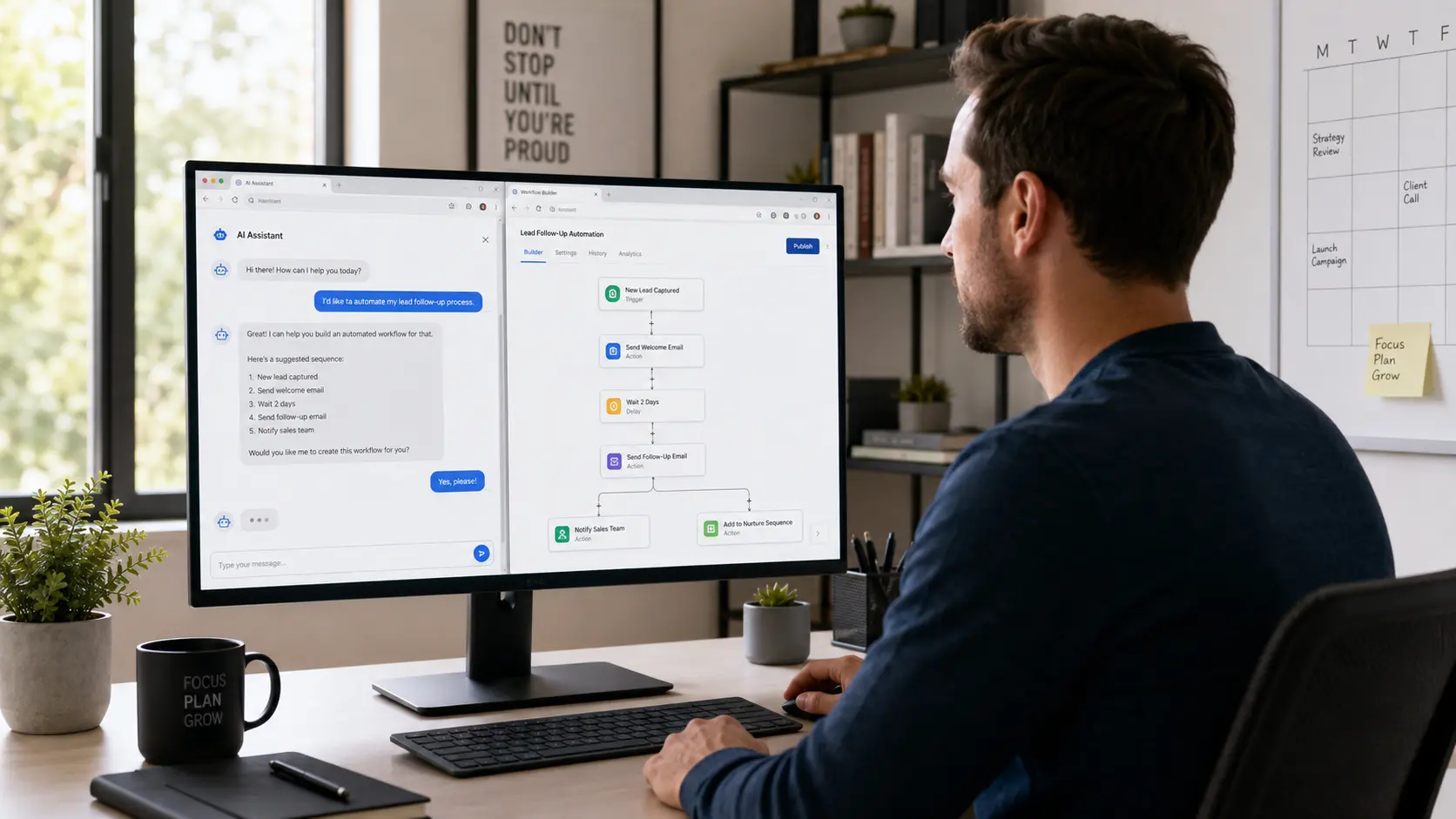
A single AI-generated post that performs well is a fluke. A repeatable system that produces, tests, and distributes content consistently is a business asset. The operators pulling ahead in 2026 are documenting their workflows, training their teams on them, and treating AI-assisted processes as intellectual property. They are building what you might call an AI-Integrated Operating System for their brand — a set of connected processes that run whether or not they are in the room.
What This Looks Like for Your Brand
For business owners and marketing teams, the practical application comes down to three immediate actions:
- Audit your current skill stack. List the capabilities you and your team already own. Identify the one or two additions that would create the most leverage when combined with AI tools.
- Pick one AI workflow to systematize this month. Not ten. One. Build it properly, document it, measure the output quality, and refine it before adding another.
- Stop treating AI as a cost-cutter and start treating it as a capability-expander. The brands that win are not using AI to do the same work cheaper. They are using it to do work at a scale and speed that was previously impossible for a team their size.
The Real Competitive Advantage
The businesses that will dominate their categories by the end of 2026 are not the ones with the most sophisticated AI stack. They are the ones that combined genuine operator expertise with smart, systemized AI execution early enough to build a lead.
The Skill Stacking method is not a new idea dressed up in AI language. It is a proven model for building durable professional value — and right now, it happens to be the exact framework that determines who AI works for and who AI works against.
The question is not whether AI will matter to your business. It already does. The question is whether you are building the human foundation that makes it work for you.
Frequently Asked Questions
What is Skill Stacking and how does it apply to AI?
Skill Stacking is a method of building professional value by combining multiple complementary skills rather than mastering just one. Applied to AI, it means developing strong business fundamentals — marketing, sales, operations, content — and then using AI tools to execute those skills at greater speed and scale. The stack is what creates advantage; AI is what amplifies it.
Is it too late to start building an AI-integrated business strategy in 2026?
It is not too late, but the urgency is real. Early adopters have a head start, but the majority of businesses are still operating without systematized AI workflows. Moving now — with intention and a focus on building repeatable systems — still puts you ahead of most competitors. The key is to act this quarter, not this year.
What is the biggest mistake businesses make when adopting AI?
The most common mistake is using AI to replace strategic thinking rather than to handle execution volume. AI excels at producing drafts, formatting data, repurposing content, and scaling output. It does not replace the human judgment required for positioning, offer creation, and brand decision-making. Brands that outsource thinking to AI quickly find their output becomes generic and indistinguishable.
How do I know which AI workflow to build first?
Start with the task that is currently consuming the most time from your highest-skilled team members. If your best marketer is spending hours on first-draft copywriting, that is your first workflow to systematize with AI. The goal is to free up human judgment for higher-leverage decisions while AI handles repeatable execution tasks.
Inspired by insights from Alex Hormozi. Adapted and expanded for the AskLibra audience.