

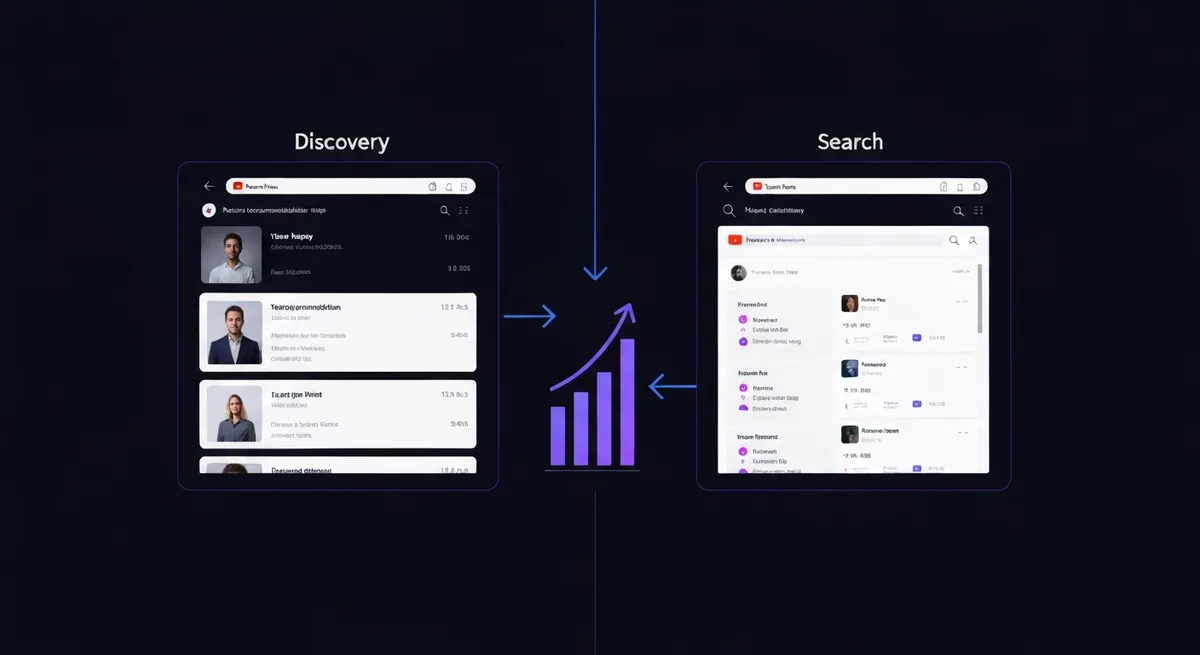
Social SEO: Discovery vs. Search — How YouTube's Two Traffic Engines Actually Work
Key Takeaways
- 1
YouTube operates two distinct traffic engines — algorithmic discovery and keyword search — and confusing them kills channel growth.
- 2
Discovery traffic rewards thumbnails, hooks, and viewer satisfaction signals, while search traffic rewards keyword-matched titles, descriptions, and watch time.
- 3
Winning creators build content strategies that serve both engines simultaneously, using metadata for search and emotional packaging for discovery.
- 4
Auditing your YouTube Studio traffic sources every 30 days tells you which engine to double down on for your specific niche.
The Two Engines Powering Every YouTube View
Most creators treat YouTube like a single platform with a single algorithm. That mental model is costing them views. YouTube actually runs two fundamentally different traffic engines underneath the hood: algorithmic discovery and keyword search. Each engine has its own ranking signals, its own audience psychology, and its own content requirements. Optimizing for one while ignoring the other is like driving a car with two flat tires and calling it a steering problem.
This guide breaks down exactly how each engine works, what signals feed each one, and how to build a content strategy that extracts maximum value from both. If you want to understand why your views plateau, this is the article that connects the dots.
What Is Discovery Traffic?
Discovery traffic is what YouTube sends you when the algorithm decides to place your video in front of a user who was not actively searching for it. This includes Homepage recommendations, the Suggested Videos sidebar, the "Up Next" queue, and the Shorts feed. The viewer wasn't looking for you. YouTube put you in their path.
The algorithm makes that decision based on one core question: Will this video satisfy this specific viewer right now? To answer that question, YouTube weighs several behavioral signals:
- Click-Through Rate (CTR): Does the thumbnail and title make people tap?
- Average View Duration and Viewer Satisfaction: Once they click, do they stay and feel good about it?
- Session Initiation: Does your video start a YouTube session rather than end one?
- Likes, Comments, and Shares: Do viewers engage after watching?
Discovery traffic is primarily an audience-matching game. YouTube studies who has watched and enjoyed videos similar to yours, then surfaces your content to people with matching behavioral profiles. This is why understanding VSAT: The Only Metric That Matters for YouTube Channel Growth is so critical — viewer satisfaction is the fuel that powers the discovery engine.
What Is Search Traffic?
Search traffic arrives when a viewer types a query into YouTube's search bar and your video appears in the results. The viewer has declared explicit intent. They know what they want. Your job is to match that intent precisely and then deliver on the promise.
YouTube's search ranking algorithm prioritizes:
- Keyword relevance: Does your title, description, and transcript contain the exact terms the viewer searched?
- Watch time on the search result: After clicking your video from search results, do viewers stay long enough?
- Channel authority in the topic: Has your channel published multiple videos on this subject?
- Recency (for some queries): Is your video fresh enough for time-sensitive searches?
Search traffic is an intent-matching game. The viewer tells YouTube what they want; YouTube finds the most relevant, trustworthy answer. This is why Unlocking the 'Golden Ratio' for YouTube Titles and Thumbnails matters — your title must serve both the human scanner and the search index simultaneously.
Why Creators Confuse the Two (And Pay For It)
The confusion happens because both engines deliver views, and both show up in your YouTube Studio analytics under "Traffic Sources." But the content requirements for each are meaningfully different.
A video optimized purely for search might have a precise, keyword-dense title like "How to Fix a Dripping Faucet in 10 Minutes" — but if the thumbnail is boring and the first 30 seconds are slow, it will get zero discovery traffic. YouTube won't recommend it because viewers who stumble on it won't click.
A video optimized purely for discovery might have a punchy, curiosity-driven thumbnail and hook — but if the title contains no searchable keywords, it will never rank for queries. It relies entirely on the algorithm choosing to push it, which is a fragile position.
This mismatch is one of the core reasons covered in Understanding Why Your YouTube Channel Might Not Be Growing: 5 Common Reasons and Solutions. Channels stall when they accidentally serve only one engine.
The Signals Each Engine Reads
Discovery Engine Signals
The discovery engine is essentially a massive collaborative filtering system. It doesn't read your title as carefully as it reads who watched your video and what else they watch. Key inputs include:
Thumbnail emotion: Does your thumbnail trigger curiosity, surprise, or desire? Discovery placements are high-competition visual environments. If your thumbnail blends in, you get skipped. Think of the thumbnail as a billboard on a highway — it has 0.3 seconds to work.
Hook rate: The percentage of viewers who watch past the 30-second mark is a powerful discovery signal. A weak hook tells YouTube that even interested viewers don't find the content compelling. For a deep dive on this, see Mastering YouTube: What Will Be a Good Hook Rate in 2026?
Retention curves: YouTube's system watches where viewers drop off. Cliffs in the first 30 seconds suppress discovery reach dramatically. The strategies in The Retention Bridge: Fixing the 30-Second Drop directly address this.
Repeat viewers and subscriber conversion: If viewers who find you through discovery subscribe or return, the algorithm treats your channel as "high value" and amplifies distribution further.
Search Engine Signals
The search engine reads your metadata far more literally. It processes:
Title keyword placement: The primary keyword should appear in the first 60 characters of your title. YouTube's index weights title keywords heavily for search ranking.
Description depth: A well-written 200–300 word description using natural keyword variations helps YouTube understand the full context of your video, which improves ranking for long-tail related queries.
Closed captions and transcripts: YouTube's auto-generated captions are indexed. Creators who speak their target keywords clearly — especially in the first 60 seconds — gain a measurable search ranking advantage.
Chapter markers: Timestamped chapters signal structured, high-value content and can help individual sections rank in Google Search as well as YouTube Search.
How to Build a Dual-Engine Content Strategy
The goal is not to choose between discovery and search. The goal is to write every piece of content so that it feeds both engines without sacrificing either. Here is the framework:
Step 1: Start With Search Intent
Use YouTube's autocomplete, Google Trends, and tools like TubeBuddy or VidIQ to identify queries your target audience is actively typing. This gives you a keyword foundation. Your video topic now has a proven audience with declared intent.
Step 2: Repackage for Discovery
Once you have a keyword topic, ask: "What emotional angle makes this irresistible to someone who wasn't looking for it?" Transform "How to Fix a Dripping Faucet" into a thumbnail that shows a flooded bathroom and a title that reads "I Fixed This Before It Cost Me $4,000." The keyword intent is still served. But now the emotional packaging works for discovery placement too.
Step 3: Engineer the First 30 Seconds for Both
Your hook must satisfy two audiences simultaneously: the searcher who clicked expecting a specific answer, and the discovery viewer who clicked on curiosity. The solution is a problem-first hook — open by naming the exact problem or outcome the video solves. This confirms relevance for the searcher and creates stakes for the discovery viewer. For structure guidance, explore The GSO Hook-Rate Audit: Fixing the 30-Second Drop-off.
Step 4: Use B-Roll to Hold Retention
Search traffic viewers are often task-oriented — they want information fast. Discovery traffic viewers are in a browsing mindset — they want stimulation. B-roll footage satisfies both by illustrating points visually while maintaining pace. The The B-Roll Blueprint: Visual Pacing for Retention covers exactly how to deploy this technique.
Step 5: Audit Your Traffic Sources Monthly
In YouTube Studio, navigate to Analytics → Reach → Traffic Sources. This tells you what percentage of your views come from Browse Features (discovery), YouTube Search, Suggested Videos, and External sources. If your channel is over 90% search traffic, you are fragile — a ranking shift can collapse your views overnight. If you are over 90% discovery, you have zero compounding search assets. A healthy channel typically targets a 40–60 split between the two engines, adjusted for niche. Channels in instructional niches (cooking, finance, tech tutorials) naturally skew search-heavy. Entertainment and personality-driven channels skew discovery-heavy. Neither is wrong — but you must know your ratio. For niche-specific benchmarks, see Understanding YouTube Subscriber Growth by Niche.
The Niche Dimension: Which Engine Matters More for You?
Not every niche splits evenly between discovery and search. Understanding your niche's natural traffic profile is essential for prioritizing your optimization effort.
High-search niches: Personal finance, DIY home repair, coding tutorials, recipe videos, product reviews, and language learning. Viewers in these niches arrive with specific questions. Search traffic can compound for years on a single well-optimized video.
High-discovery niches: Entertainment commentary, vlogging, gaming highlights, reaction content, and motivational content. These niches thrive on emotional resonance and algorithmic amplification rather than keyword intent. A strong thumbnail and hook matter far more than description keywords.
Channels that The Micro-Niche Moat Strategy: How to Build an Unbeatable YouTube Channel in a Crowded Space describes can often dominate both engines — because micro-niche content has less competition in search and tighter audience clustering that helps the discovery algorithm identify exactly who to recommend your video to.
Common Mistakes That Starve Both Engines
Clickbait with no delivery: A high CTR followed by poor retention punishes both engines simultaneously. Discovery suppresses the video because satisfaction signals collapse. Search drops the ranking because watch time is weak.
Keyword stuffing in titles: Over-optimized titles like "Best Budget Microphone 2024 Cheap Microphone Review Under $50" hurt CTR for discovery placements because they read like spam. Lower CTR starves the discovery engine.
Ignoring posting consistency: Both engines reward channels that publish regularly. Inconsistent uploads allow competitors to accumulate the watch time and engagement signals that push them ahead in both search rankings and discovery recommendations. For the data on optimal frequency, see Mastering YouTube Success: How Often Should You Post for Maximum Growth?
Final Framework: The Dual-Engine Content Checklist
Before publishing every video, run through this checklist to confirm you are feeding both engines:
- Title: Contains primary keyword in first 60 characters AND creates curiosity or stakes for the casual browser.
- Thumbnail: Communicates a clear emotional promise that complements — not duplicates — the title text.
- Description: First 2 sentences contain natural keyword usage. Full description is 150+ words with related terms included.
- Hook (0–30 seconds): Names the problem or outcome immediately. No slow intros. No long channel branding sequences.
- Retention structure: Pattern interrupts, B-roll, and chapter breaks every 2–3 minutes to maintain viewing across both search-intent and discovery-browsing viewers.
- End screen and cards: Link to related videos to extend session watch time, which signals positively to both engines.
The creators who scale past 100,000 subscribers are almost never the ones who stumbled onto a viral moment. They are the ones who built a systematic approach to feeding both traffic engines, consistently, across every upload. Discovery gets you reach. Search gives you permanence. Together, they build a channel that compounds over time.
Ready to see what the data says about your channel?
Stop guessing. Use AskLibra to get a personalized 90-day growth gameplan and find your perfect posting window.
Get Your Free Growth ScanNo credit card required • Join 2,000+ creators