

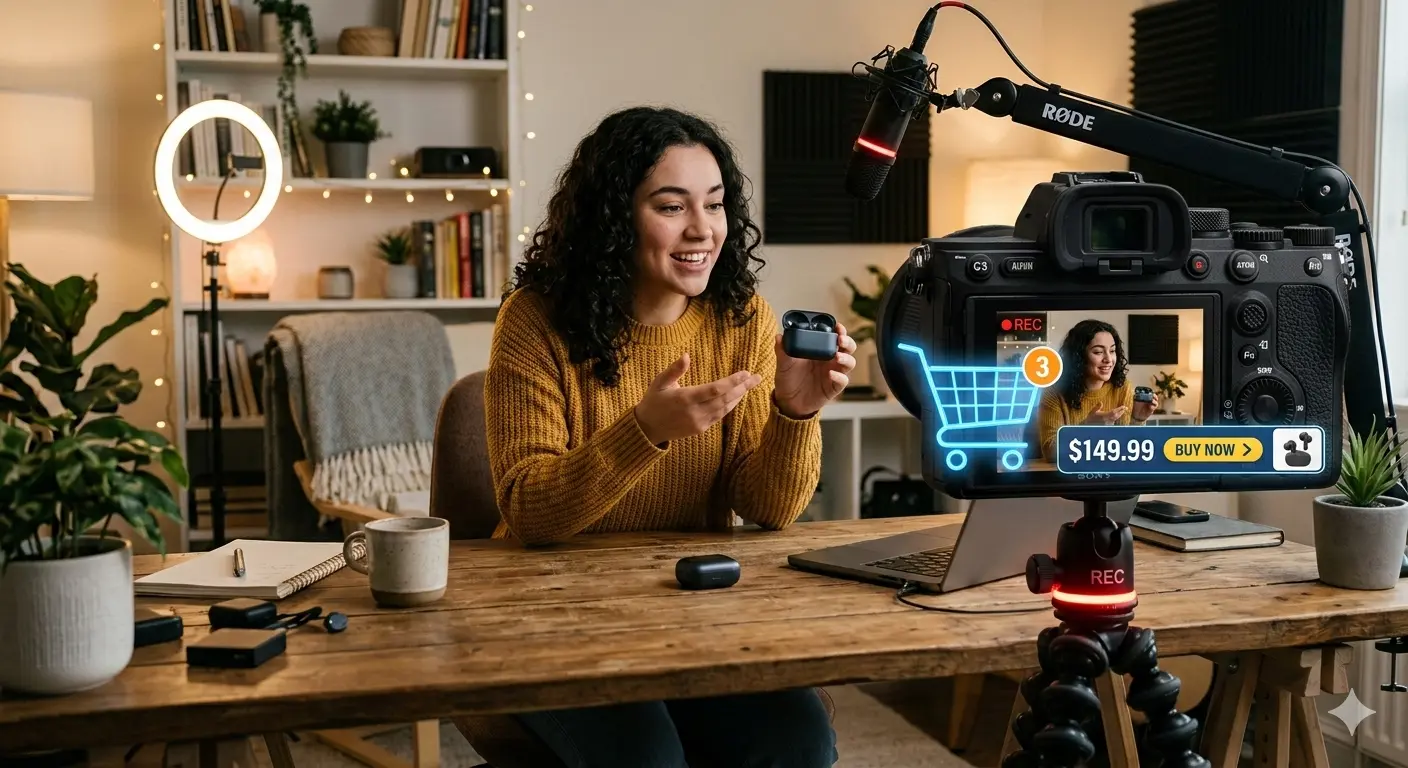
Video Commerce: Native In-App Selling for YouTube Creators
Key Takeaways
- 1
Native in-app selling lets viewers purchase products directly inside a video platform without leaving the app — and creators who master this format are converting passive watchers into buyers at measurably higher rates than link-in-bio strategies.
- 2
Longform video consistently outperforms short-form for commerce conversions because it gives creators time to demonstrate product value, handle objections, and build the trust that drives purchase decisions.
- 3
Your hook rate — the percentage of viewers who watch past the first 30 seconds — is the single most important variable in video commerce, because a viewer who clicks away before the product demo never converts.
- 4
Posting at peak audience hours and pairing native shopping features with strong retention tactics are the two levers creators can pull immediately to increase revenue per video without producing more content.
What Is Video Commerce and Why Native Selling Changes Everything
Video commerce is the practice of selling products or services directly through video content, with transactions completed inside the same platform where the video is watched. The word native is critical here: native in-app selling means the viewer never leaves YouTube, TikTok, or Instagram to complete a purchase. No redirects. No abandoned cart from a slow-loading external page. The checkout lives inside the experience.
For years, creators drove sales through affiliate links dropped in descriptions or spoken callouts to "swipe up" on Stories. That model placed enormous friction between a viewer's buying impulse and the completed sale. Native in-app selling collapses that gap. When a product tag appears on screen at the exact moment a creator demonstrates the item, the viewer can tap, review, and purchase without ever pausing the video. That seamlessness is not a convenience feature — it is a conversion engine.
The Retention Imperative: Keeping Viewers Long Enough to Buy
Native selling only works if viewers stay long enough to reach the moment you present a product. This is where hook rate — the percentage of viewers who continue watching past the first 30 seconds of a video — becomes a life-or-death metric for video commerce creators. A compelling hook buys you the time to demonstrate value, build desire, and present a purchasable product. A weak hook means the viewer is gone before the selling moment arrives.
Equally important is the retention curve, a graph inside YouTube Studio that shows the exact percentage of viewers still watching at every second of your video. A healthy retention curve for a commerce-focused video holds above 50% through the product demonstration segment. If your curve craters before you introduce a product, you have a structural scripting problem, not a product problem.
To understand how to engineer a hook that keeps viewers watching, see Why Your YouTube Hook Rate Is Killing Your Reach and Pattern Interrupt Hooks (2026 Edition): Stop the Scroll and Keep Viewers Watching. For a deep dive into improving your retention curve overall, How to Boost Your YouTube Video Retention Rates: An In-Depth Guide is the most practical starting point.
Why Long-Form Video Outperforms Shorts for Commerce
Shorts and brief social clips drive discovery. Long-form video drives transactions. The reason is psychological: purchasing a product requires trust, and trust is built through time spent with a creator. A 60-second Short can make a viewer aware of a product. A 12-minute review video can make them confident enough to buy it.
Based on AskLibra data from 4 connected channels and 511 videos analyzed, long-form content produces an average engagement rate of 0.0226 — more than double the 0.0109 recorded for Shorts. Higher engagement correlates directly with the kind of active, attentive viewing that predicts purchase intent. A viewer who pauses to read a product description, rewinds to catch a detail, or leaves a comment asking where to buy something is demonstrating purchase-ready behavior that a passive scroll-by never produces.
This does not mean abandon Shorts. Use them as awareness-layer content that funnels viewers to longer purchase-intent videos. A Short showing a dramatic before-and-after drives curiosity; the linked long-form video closes the sale.
Platform Mechanics: How Native Shopping Actually Works on YouTube
YouTube's shopping features allow eligible creators to tag products directly on videos. These tags appear as small icons on the video player; viewers tap to see product details and pricing, then complete the purchase through the brand's storefront — all without leaving YouTube. Creators earn a commission on completed sales, functioning similarly to affiliate marketing but with dramatically reduced friction because the product tag is embedded in the viewing experience itself.
To qualify, channels must meet YouTube's Partner Program requirements and connect a product catalog through YouTube's merchant integration. Once live, creators can tag products during upload or retroactively on published videos, making it possible to monetize an entire back-catalog of relevant content overnight.
CTR (Click-Through Rate) on product tags — the percentage of viewers who tap a product tag after seeing it — is the commerce equivalent of thumbnail CTR. Just as a thumbnail's job is to earn a click from the Browse feed, a product tag's job is to earn a tap from an engaged viewer. Placement matters: tags timed to appear during the exact moment of product use or demonstration outperform tags placed at the beginning or end of videos.
For a broader understanding of how YouTube's discovery and search systems send viewers to your content in the first place, Social SEO: Discovery vs. Search — How YouTube's Two Traffic Engines Actually Work explains the two distinct traffic pipelines every commerce creator must master.
Titles and Thumbnails as the First Sales Page
Before a viewer ever reaches your product tag, they must click your video. Your title and thumbnail function as the first page of your sales funnel. A commerce-optimized thumbnail shows the product in use, ideally with a visible result or transformation that creates curiosity. A commerce-optimized title answers the viewer's implicit question: "What will I gain from watching this?"
The specific ratios of text-to-image, face presence, and color contrast that drive the highest click-through rates are covered in depth in Unlocking the 'Golden Ratio' for YouTube Titles and Thumbnails. Getting this right is not cosmetic — it determines whether your commerce funnel ever gets traffic in the first place.
Posting Strategy for Commerce Creators
Video commerce is not a single-video event. It is a content system. Products with higher price points require more touchpoints before a viewer commits to a purchase. A skincare tool selling for $180 may need a first-impression video, a 30-day results video, and a comparison video before a viewer feels confident enough to buy. Each video in that sequence needs to be published consistently enough that viewers stay subscribed and engaged between installments.
Consistency also signals trust. A channel that posts erratically feels abandoned; a channel with a predictable cadence feels professional and authoritative — exactly the perception required for commerce. For data-backed posting frequency guidance, see Mastering YouTube Success: How Often Should You Post for Maximum Growth?.
Trust as the Foundation of Every Transaction
Native in-app selling adds convenience, but it does not manufacture trust. Viewers purchase from creators they believe are honest. In an environment where sponsored content disclosures are legally required and viewers have become skilled at detecting inauthentic recommendations, transparency is not optional — it is a competitive advantage.
Creators who clearly disclose partnerships, show genuine product use, and acknowledge limitations alongside benefits consistently outperform creators who produce promotional content that reads as advertising. This is especially true for repeat purchases: a viewer who feels deceived once will never buy again. A viewer who feels respected and accurately informed becomes a repeat customer and a word-of-mouth advocate.
For the frameworks around content credibility and verification that underpin viewer trust, Digital Provenance & Trust Labels: The Creator's Guide to Verified Content in 2025 is essential reading.
Measuring What Actually Drives Revenue
Most creators track views and subscriber counts. Commerce creators must track a different set of metrics: product tag tap rate, add-to-cart rate, conversion rate by video, and revenue per thousand views (RPM from commerce, separate from ad RPM). These numbers tell you whether your content is actually moving product, not just generating impressions.
VSAT (Viewer Satisfaction and Attention Time) — a composite metric that measures how satisfied viewers are based on watch time, engagement actions, and return visit behavior — is particularly relevant for commerce creators because satisfied, returning viewers are exponentially more likely to purchase than first-time visitors. VSAT: The Only Metric That Matters for YouTube Channel Growth explains how to interpret and improve this score.
For creators ready to move beyond gut-feel decisions, The Guessing Game Is Over: Why Creators Who Don't Use Data Are Leaving Money on the Table makes the case for analytics-driven content strategy with concrete examples.
Frequently Asked Questions
What is the difference between affiliate marketing and native in-app selling?
Affiliate marketing uses external links — typically in the video description — that take viewers away from YouTube to complete a purchase on a retailer's website. Native in-app selling embeds the product purchase directly inside the platform, so viewers tap a product tag on the video itself and complete the transaction without leaving. Native selling reduces friction and typically produces higher conversion rates because the buying moment coincides with peak viewing engagement.
Do I need a large subscriber count to use YouTube's shopping features?
YouTube requires creators to be part of the YouTube Partner Program (YPP) to access shopping features, which has its own subscriber and watch-hour thresholds. Beyond YPP eligibility, there is no minimum subscriber count specifically for product tagging — a channel with 2,000 highly engaged subscribers in a specific niche can outperform a generalist channel with 200,000 subscribers in commerce conversion because niche audiences have stronger purchase intent for relevant products.
What types of products perform best in video commerce?
Products that benefit from demonstration — tools, beauty items, kitchen equipment, fitness gear, tech accessories — consistently outperform products that do not have a visible use case. Viewers need to see the product working in context to feel confident purchasing it. Price point also matters: items between $20 and $150 have the lowest purchase hesitation in a video context, while higher-ticket items require a longer content sequence to build sufficient buyer confidence.
How do I time product tags for maximum tap-through rate?
Product tags should appear on screen during the exact moment of active product demonstration — when the creator is using, applying, or showing results from the item. Tags placed at the start of a video (before trust is established) or at the very end (when viewers have already disengaged) produce significantly lower tap rates. Test tag placement across multiple videos and compare tap-through rates in YouTube's analytics to find your channel's optimal window.
Can I use Shorts to sell products through native shopping?
YouTube has been expanding shopping tag availability to Shorts, though feature rollout varies by region and account eligibility. Even where Shorts shopping tags are available, long-form video remains more effective for closing sales because it provides the watch time needed to build trust and demonstrate product value. The most effective strategy uses Shorts for product awareness and discovery, then links to a long-form video where the detailed demonstration and purchase tag live.
Ready to see what the data says about your channel?
Stop guessing. Use AskLibra to get a personalized 90-day growth gameplan and find your perfect posting window.
No credit card required • Join 2,000+ creators