

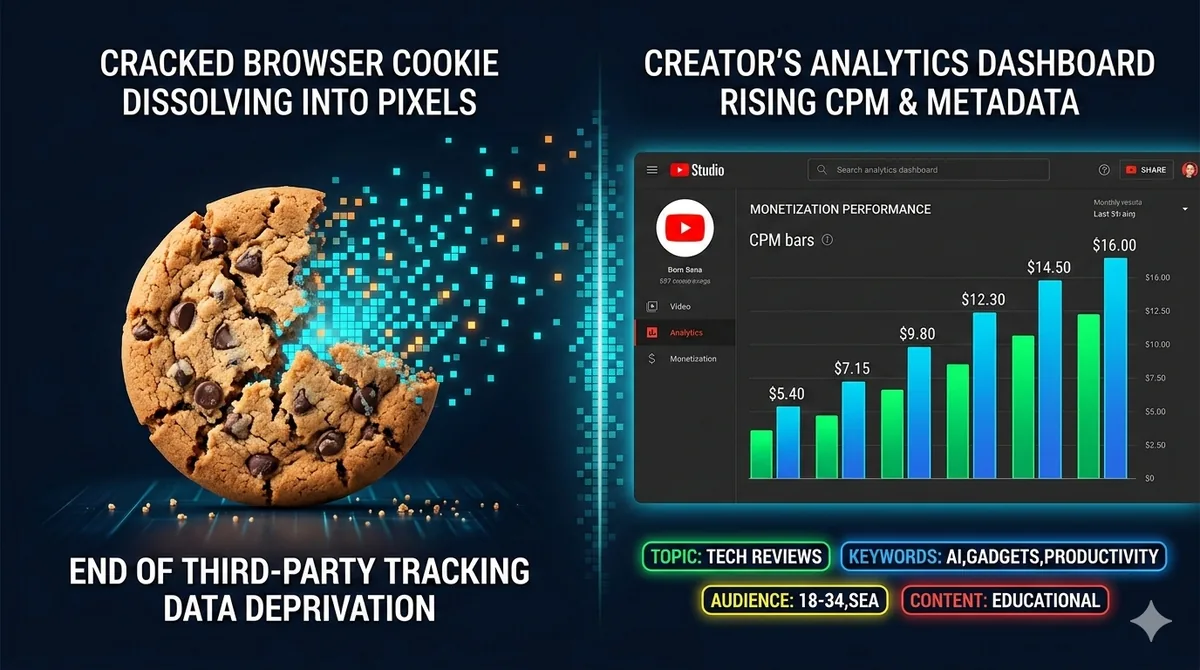
The Decline of Third-Party Cookies: What Every YouTube Creator Needs to Know
Key Takeaways
- 1
Third-party cookies — the tracking scripts advertisers place on websites to follow users across the web — are being phased out, shifting ad revenue dynamics and targeting precision for YouTube creators.
- 2
Creators who build first-party audience relationships through subscribers, email lists, and community posts will be insulated from the CPM drops that cookie deprecation causes for broad, untargeted inventory.
- 3
Long-form video content, which naturally attracts higher advertiser bids due to mid-roll placement and contextual targeting signals, becomes significantly more valuable as cookie-based retargeting weakens.
- 4
Understanding how YouTube's contextual ad system works — and optimizing your content's topic signals — is now a direct monetization lever every creator can control.
What Are Third-Party Cookies and Why Should Creators Care?
A third-party cookie is a small data file placed in a user's browser by a domain other than the website they are visiting — typically an advertising network or data broker. These cookies have been the backbone of digital advertising for two decades, allowing brands to track a user who visits a shoe store on Monday and serve them shoe ads on YouTube by Wednesday. For creators, this tracking infrastructure quietly inflated CPMs (cost per thousand views — the price advertisers pay per thousand ad impressions) by making audience targeting precise and efficient.
Now that infrastructure is crumbling. Apple's Safari and Mozilla's Firefox blocked third-party cookies years ago. Google, which processes the majority of YouTube's advertising revenue through its ad network, has been executing a multi-year deprecation plan for Chrome — the browser used by roughly two-thirds of internet users globally. The result is a seismic shift in how advertisers buy audiences, and creators who ignore it will feel it directly in their revenue dashboards.
How Cookie Deprecation Changes Advertiser Behavior
When advertisers cannot track users across the web, two things happen simultaneously. First, retargeting campaigns — the high-CPM ads that chase users who have already shown purchase intent — become far less effective and therefore cheaper to run. This compresses premium ad rates across the board. Second, advertisers shift budget toward contextual targeting: placing ads based on the content being watched rather than the viewer's browsing history.
This second shift is critically important for creators. Contextual targeting means a cooking channel now attracts cooking appliance ads not because the viewer was tracked shopping for blenders, but because the video itself signals a relevant environment. The quality and clarity of your content's topic signals — your title, description, tags, spoken keywords, and chapter markers — become direct inputs into how much advertisers will pay to appear alongside your videos.
If your channel has a blurry niche identity, contextual ad systems struggle to match you with premium buyers. This is precisely why The Micro-Niche Moat Strategy: How to Build an Unbeatable YouTube Channel in a Crowded Space is not just a growth tactic — it is a monetization defense in a post-cookie advertising landscape.
The Format That Wins When Cookies Disappear
Not all video formats are affected equally. Short-form content — Shorts and videos under three minutes — carries limited ad inventory and relies heavily on broad demographic targeting that was historically informed by cookie data. Long-form content, by contrast, supports mid-roll ads, which command higher bids, and provides richer contextual signals through extended spoken content, chapter structures, and viewer behavior patterns.
Based on AskLibra data from 4 connected channels and 511 videos analyzed, long-form content generates an average engagement rate of 0.0226 — more than double the 0.0109 average seen in short-form content. Higher engagement signals to both the YouTube algorithm and to advertisers that viewers are genuinely invested in the content, making those placements more desirable to premium contextual buyers. If you have been debating whether to invest in longer videos, the post-cookie advertising environment provides a concrete financial reason to do so.
First-Party Data: The Creator's New Competitive Advantage
The advertising industry's response to cookie deprecation has centered on first-party data — information that audiences voluntarily share directly with a platform or creator. For YouTube creators, first-party data means subscribers, channel memberships, Super Chat participants, email newsletter subscribers, and community post engagement. These audiences self-select, which makes them inherently more valuable to advertisers than anonymous cookie-tracked users.
Brands are increasingly willing to sponsor creators with highly engaged, identifiable audiences rather than purchase programmatic ad inventory on channels with inflated view counts and anonymous viewers. This is why The Guessing Game Is Over: Why Creators Who Don't Use Data Are Leaving Money on the Table is a timely framework — knowing your audience's watch behavior, retention patterns, and engagement peaks is now the asset you bring to brand conversations.
A creator who can tell a sponsor "my audience of 45,000 subscribers watches an average of 68% of every video and peaks at 4 PM" is selling something no programmatic cookie-based system can replicate after deprecation.
How YouTube's Contextual System Will Fill the Gap
YouTube has been building its contextual ad infrastructure — called VSAT (Viewer Satisfaction and Targeting) — for years in anticipation of cookie loss. VSAT, which you can read about in detail in VSAT: The Only Metric That Matters for YouTube Channel Growth, evaluates whether a viewer was satisfied with a video using retention data, likes, shares, and subsequent watch behavior. Channels with high VSAT scores receive preferential distribution — and now, increasingly, preferential ad matching.
The practical implication is straightforward: improving your retention curve (the graph showing what percentage of viewers are still watching at each moment of your video) is no longer just an algorithmic concern — it is a revenue optimization strategy. A video that holds 60% of viewers to the halfway point tells YouTube's contextual system that the content is high-quality and relevant, making it a more attractive environment for premium ad placements. For a detailed breakdown of how to read and improve your retention curve, see How to Boost Your YouTube Video Retention Rates: An In-Depth Guide.
Titles, Thumbnails, and Metadata as Monetization Signals
In a contextual targeting world, your video's metadata is not just a discoverability tool — it is an advertising targeting signal. YouTube's ad system reads your title, description, and tags to determine which advertiser categories to match with your content. A vague title like "My Weekend Vlog" provides almost no contextual signal. A specific title like "Building a Sourdough Starter from Scratch: Day 1 to Day 7" tells the system to serve food, kitchenware, and grocery advertiser bids.
This is the practical reasoning behind the principles outlined in Unlocking the 'Golden Ratio' for YouTube Titles and Thumbnails. Strong titles that front-load specific nouns and actions do double duty: they attract clicks from viewers browsing the feed, and they communicate clear topic signals to both the YouTube search index and the advertising targeting system.
For creators navigating how these two functions interact, Social SEO: Discovery vs. Search — How YouTube's Two Traffic Engines Actually Work provides an essential map of how discoverability and monetization signals overlap in YouTube's infrastructure.
Trust, Verification, and the Post-Cookie Creator Economy
One underappreciated consequence of cookie deprecation is an increase in advertiser scrutiny around brand safety. When targeting was user-based, brands could avoid placing ads next to problematic content through audience filters. As targeting shifts to content-based signals, brands need to verify that the content environment itself is trustworthy and brand-safe.
Creators who invest in content credibility — accurate information, clear sourcing, consistent on-brand presentation — will be rewarded with access to premium advertiser categories with higher CPM floors. This connects directly to the principles in Digital Provenance & Trust Labels: The Creator's Guide to Verified Content in 2025, which outlines how verified, trustworthy content signals attract both algorithmic distribution and advertiser confidence.
Practical Steps for Creators Starting Today
The transition away from third-party cookies is not a future event — it is an ongoing process with direct, measurable effects on creator revenue. Here are the concrete actions that insulate your channel from the worst outcomes:
1. Sharpen your niche identity. Every video you publish should reinforce a clear topical signal. Contextual ad systems reward consistency. A channel that covers personal finance, productivity, and travel confuses both the algorithm and the advertiser matching system.
2. Optimize your metadata deliberately. Write descriptions that use the specific nouns an advertiser in your category would recognize. Include chapter markers with descriptive labels. These are read by YouTube's contextual ad system.
3. Prioritize subscriber conversion. Every new subscriber is a unit of first-party data. Use end screens, pinned comments, and calls-to-action at high-retention moments in your videos. For guidance on when viewers are most receptive, analyze your retention curve weekly.
4. Build off-platform lists. An email list or a Discord community gives you an audience asset that no platform algorithm or cookie policy can deprecate. Sponsors increasingly value creators who can demonstrate multi-platform reach to an identified audience.
5. Track your engagement rate, not just your view count. In a contextual advertising market, a smaller, highly engaged audience commands better sponsorship rates than a large, passive one. Use platform analytics to monitor which video formats and topics drive the highest engagement ratios.
Frequently Asked Questions
What exactly is a third-party cookie and how does it affect my YouTube revenue?
A third-party cookie is a tracking file placed by an advertiser's network in a viewer's browser, allowing that advertiser to follow the viewer across different websites and serve targeted ads. When these cookies work, advertisers pay premium CPM rates because they can precisely target purchase-ready audiences. As cookies are deprecated, that precision disappears, which can reduce CPMs for channels that rely on broad, untargeted programmatic ad inventory.
Will my CPM definitely drop when third-party cookies are fully removed?
Not necessarily, and not uniformly. Channels with clear niche identities, strong contextual signals in their metadata, and high viewer engagement are positioned to maintain or improve CPMs as advertisers shift budget toward contextual placements. Channels with vague identities and low retention are most exposed to CPM compression because contextual systems cannot efficiently match them with premium advertisers.
How does YouTube decide which ads to show on my videos without cookie data?
YouTube's ad system uses contextual signals — your video title, description, tags, spoken content detected through automatic captions, chapter markers, and viewer engagement patterns — to determine which advertiser categories are relevant to your content. It also uses aggregated, anonymized audience signals from viewers who are signed into Google accounts, which constitutes a form of first-party data that Google retains regardless of cookie policy changes.
What is VSAT and why does it matter for ad revenue after cookie deprecation?
VSAT stands for Viewer Satisfaction and Targeting, a metric YouTube uses to evaluate whether viewers found a video satisfying based on retention, engagement, and subsequent behavior. High VSAT scores improve both algorithmic distribution and ad placement quality. In a contextual ad market, videos that demonstrably satisfy viewers attract higher advertiser bids because the viewing environment signals genuine audience attention rather than passive exposure.
Should I stop making Shorts and focus only on long-form content?
Shorts serve a discovery and subscriber acquisition function that remains valuable, but they should not be your primary monetization vehicle in a post-cookie environment. Long-form videos carry richer contextual signals, support mid-roll ad placements, and generate higher engagement rates — all of which translate to stronger advertiser matching. A balanced strategy uses Shorts to attract new viewers and long-form content to monetize them effectively.
Ready to see what the data says about your channel?
Stop guessing. Use AskLibra to get a personalized 90-day growth gameplan and find your perfect posting window.
Get Your Free Growth ScanNo credit card required • Join 2,000+ creators