

Why YouTube Videos Get Low Views (How to Fix It)
Key Takeaways
- 1
Low views are almost always caused by weak CTR, poor early retention, or content-audience mismatch — not bad luck.
- 2
The algorithm tests every video on a small audience first; if that test fails, the video gets buried.
- 3
Fixing low views requires diagnosing which signal is broken before making changes.
Low YouTube Views Are a Signal Problem, Not a Luck Problem
When a video gets low views, most creators assume the topic was wrong or the niche is too competitive. Usually, that is not the cause. YouTube distributes every new video to a small test audience first. If that test audience clicks the thumbnail and keeps watching, the algorithm expands distribution. If they do not, the video stops getting pushed. Low views mean the test failed — and that failure is almost always traceable to one of three broken signals: click-through rate, early retention, or content-audience fit.
Before changing anything, you need to know which signal is broken. Changing your thumbnails when your real problem is a weak hook wastes time and creates misleading data. This article gives you a clear framework to diagnose the actual cause and then fix it.
The 3 Root Causes of Low YouTube Views
1. Low Click-Through Rate (CTR)
CTR — click-through rate — is the percentage of people who see your thumbnail and title and actually click. If your CTR is below 2-3%, YouTube interprets your video as low-interest and stops surfacing it. A strong CTR signals that your packaging is working. A weak CTR means your thumbnail or title is not compelling enough for the audience seeing it.
To understand what a healthy CTR looks like and what drives it, read What is YouTube CTR and why does it control your channel's growth? before changing any thumbnails. For specific thumbnail fixes, How to Improve Your YouTube Thumbnail Click-Through Rate gives a practical checklist you can act on immediately.
2. Poor Audience Retention in the First 30 Seconds
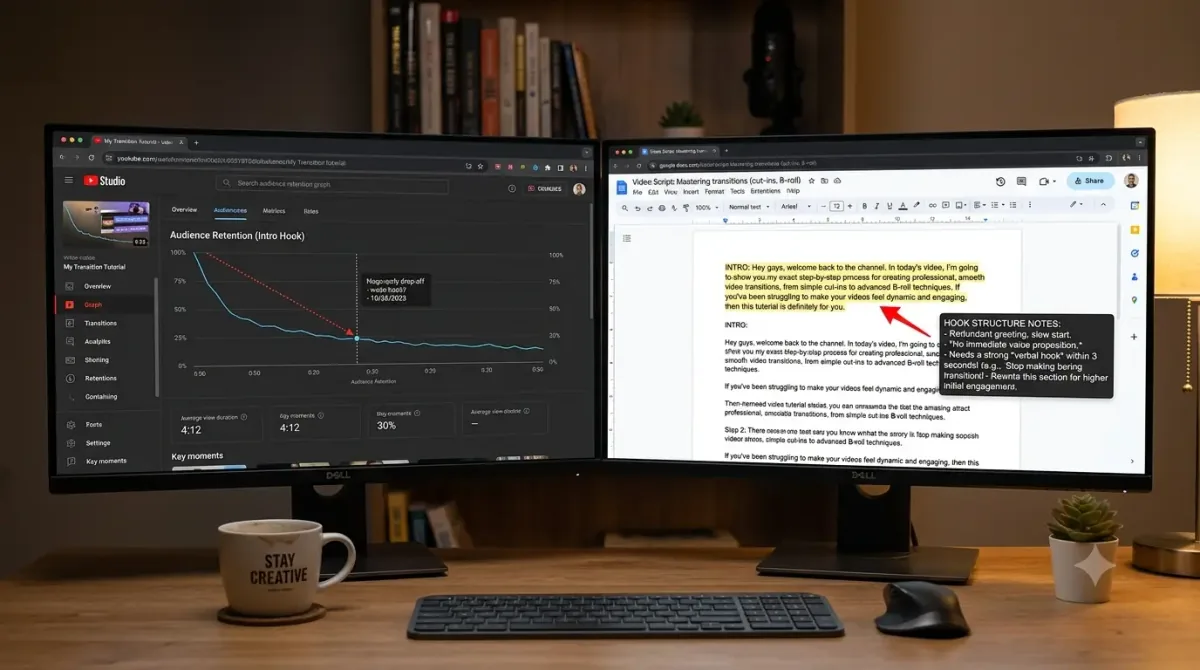
Even if people click, they need a reason to stay. YouTube tracks what percentage of viewers watch past the first 30 seconds — this is your hook rate. If your hook rate is below 70%, the algorithm reads your video as low-quality and pulls back on distribution. The opening of your video needs to immediately confirm to viewers that clicking was the right decision.
A weak hook is one of the most common and most fixable causes of low views. How to Improve Your YouTube Hook Rate breaks down exactly how to restructure your openings. You can also see how this plays into overall reach in Why Your YouTube Hook Rate Is Killing Your Reach.
3. Content-Audience Mismatch
Sometimes a video gets decent clicks and decent early retention, but still plateaus quickly. This happens when the content drifts away from what your existing audience expects or when you are targeting a topic that attracts the wrong viewers entirely. YouTube's algorithm learns what your channel is about based on who watches you. If your content keeps pulling in random or uninterested viewers, the algorithm loses confidence in who to recommend your channel to.
Solving this requires looking at your analytics honestly. How to Use Data to See What Your YouTube Channel Needs shows you how to read your own channel signals to understand what your audience actually wants — not just what you think they want.
How to Diagnose Which Problem You Have
Use this decision framework before making any changes to your channel:
Check impressions first. If impressions are high but views are low, your CTR is the problem. If impressions are low, your channel has a distribution problem — often caused by past videos training the algorithm poorly.
Check CTR next. Open YouTube Studio and look at the CTR for the underperforming video. Below 3% on browse and suggested traffic means your thumbnail or title needs work.
Check your audience retention graph. If you see a steep drop in the first 30 seconds, your hook is broken. If retention holds early but falls off sharply at a specific point, that section of the video is losing people.
Check who is watching. If your returning viewer percentage is low and your click-through from browse features is weak, your content may be misaligned with your established audience.
Check posting time. Uploading when your audience is offline means fewer early clicks and poorer test performance. How to Find Your Best Posting Time on YouTube Using Your Own Data shows how to find your optimal window from your own analytics.
What to Fix First
Fix only one variable at a time. If you change your thumbnail, title, hook, and posting time simultaneously, you will not know what actually moved the needle. Here is the priority order:
If CTR is below 3%: Test a new thumbnail on the underperforming video. Make the subject clearer, increase contrast, and remove clutter. Then write a title that answers a specific question or creates clear curiosity.
If hook rate is below 70%: Recut your opening. Remove filler, avoid long intros, and state the value of the video in the first 15 seconds. How AI Makes YouTube Videos Flow Better covers tools that can help you identify weak points in your video structure.
If content-audience fit is the issue: Use your analytics to identify which past videos performed best with your core audience, then plan your next videos around those topics. How to Create a Content Strategy Using Only Your YouTube Analytics Data gives you a repeatable process for this.
How to Prevent Low-View Videos Going Forward
Low views on individual videos are normal. A pattern of low views across your channel means there is a structural problem. Channels that consistently grow treat every video as a data point. They track CTR, hook rate, and average view duration for every upload and use that data to make better decisions on the next one.
Topical consistency also matters for long-term distribution. When YouTube understands what your channel covers, it gets better at recommending your videos to the right people. Topic Clustering and Content Neighborhoods explains how to structure your content so the algorithm builds a clear picture of your channel over time.
If you want to generate video ideas that are more likely to resonate with your specific audience before you invest time in production, How to Use AI to Generate YouTube Video Ideas That Actually Match Your Audience gives you a practical workflow for doing that with your real channel data.
What to Do Next
Open YouTube Studio right now and pull the analytics on your three most recent low-performing videos. Look at impressions, CTR, and the retention graph for each one. You will almost certainly see a pattern — the same signal breaking in the same place. Fix that one thing on your next upload and measure the result before changing anything else.
If you want a faster read on your channel's weak points without manually digging through Studio, AskLibra connects to your YouTube data and surfaces exactly which metrics are holding your channel back.
Frequently Asked Questions
Why do my YouTube videos get low views even with good tags?
Tags have minimal impact on YouTube distribution. The algorithm relies primarily on CTR, audience retention, and watch time signals — not tags. If your videos are getting low views, check your thumbnail performance and hook rate in YouTube Studio before adjusting metadata.
How long does it take YouTube to push a video after uploading?
YouTube typically runs its initial distribution test within the first 24-48 hours after upload. If a video does not gain traction in that window, it is unlikely to grow organically without an external traffic source or a change to the thumbnail and title to restart the test.
Can I fix a video that already has low views?
Yes. Changing the thumbnail and title of an existing video can restart YouTube's distribution test and bring new impressions. This works best within the first 2-4 weeks. After that, the video is harder to revive without significant external traffic.
What is a good CTR on YouTube?
A CTR between 4-10% is generally considered strong on YouTube, though averages vary by channel size and traffic source. Browse feature traffic tends to have higher CTR than suggested video traffic. Anything below 2% on browse traffic usually signals that the thumbnail or title needs reworking.
Does posting frequency affect how many views I get?
Frequency matters less than consistency and quality. Posting more often does not guarantee more views, but a consistent schedule trains your audience and signals to the algorithm that your channel is active. Posting at the wrong time, however, can hurt your initial test performance — which is why finding your optimal posting window matters.
Ready to see what the data says about your channel?
Stop guessing. Use AskLibra to get a personalized 90-day growth gameplan and find your perfect posting window.