
What is a YouTube Hook and How Long Should It Be?
Key Takeaways
- 1
A YouTube hook is the opening segment of your video — typically the first 15 to 30 seconds — whose sole job is to stop a viewer from clicking away before your content begins.
- 2
Hook length is not one-size-fits-all: short-form content (Shorts) demands a hook under 3 seconds, while long-form tutorials can sustain a hook up to 30 seconds if it delivers a clear, specific promise.
- 3
Hook rate — the percentage of viewers who watch past your opening segment — is a direct signal YouTube uses to decide whether to push your video to more people.
- 4
The strongest hooks combine a concrete problem statement, a specific outcome, and an implicit reason to stay — not a vague tease or a slow introduction.
What Exactly Is a YouTube Hook?
A YouTube hook is the opening segment of your video — everything you say, show, or imply in the first few seconds — whose single purpose is to convince a viewer to keep watching. It is not your intro animation, your channel name reveal, or a thank-you to subscribers. It is the immediate, visceral answer to the question every viewer is silently asking the moment your video starts: "Why should I keep watching this instead of clicking on something else?"
A hook works by making a promise. That promise can take the form of a problem the viewer recognizes, a surprising statement they have not heard before, or a specific result they want to achieve. The moment a viewer believes your video will deliver something valuable to them personally, your hook has done its job.
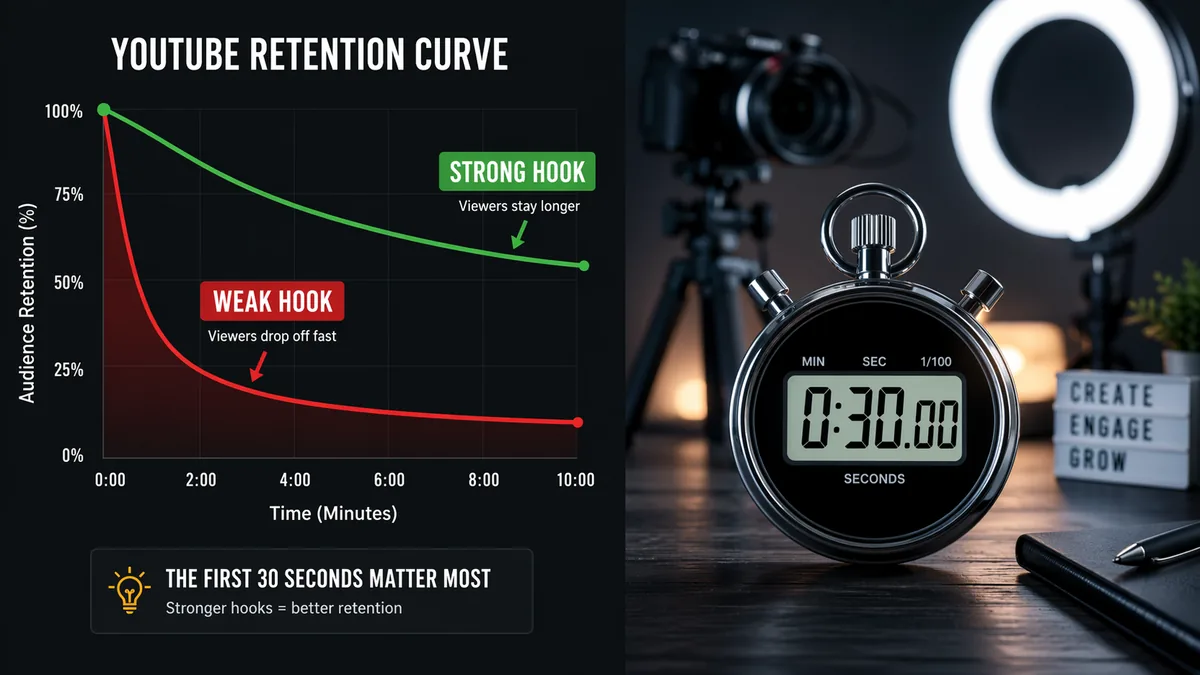
Understanding hooks is inseparable from understanding YouTube Audience Retention: What the Numbers Actually Mean. Retention data is the direct scoreboard for your hook — a steep early drop in the retention curve almost always points to a hook that failed to deliver on the promise your thumbnail and title made.
Hook Rate: The Metric That Matters Most
Hook rate is the percentage of viewers who continue watching past your opening segment — typically measured at the 30-second mark for long-form videos. If 1,000 people start your video and 600 are still watching at 30 seconds, your hook rate is 60%. A strong hook rate signals to the YouTube algorithm that your opening is compelling, which increases the likelihood the platform will distribute your video more widely.
This matters because the algorithm does not watch your video — it reads viewer behavior. A high hook rate is one of the clearest behavioral signals a creator can send. To understand the full picture of how these signals interact, see What is the YouTube Algorithm in 2026? A Data-Driven Breakdown.
How Long Should a YouTube Hook Actually Be?
This is the most common question creators ask, and the honest answer is: it depends on the format. Here is a practical breakdown:
YouTube Shorts: 0 to 3 Seconds
On Shorts, you have no runway. The viewer's thumb is already moving. Your hook must be visual, immediate, and specific. A question on screen, a surprising action, or a bold text overlay in the first two seconds is not optional — it is the entire format strategy. Any soft opening on a Short is a deleted view.
Standard Long-Form Videos: 15 to 30 Seconds
For videos between 8 and 20 minutes, your hook window is roughly 15 to 30 seconds. Within that window, you need to accomplish three things: identify the viewer's problem, hint at the specific solution or outcome, and give them a reason to believe you are the right person to deliver it. After 30 seconds without a clear promise, most viewers have already made up their minds.
Deep-Dive or Tutorial Content: Up to 45 Seconds
Long-form educational content — think 30-minute walkthroughs or multi-step tutorials — can sustain a slightly longer hook if every second is earning its place. In this format, creators often use a "results first" structure: show the finished product, the final dashboard, or the end state before explaining how to get there. This extends the hook without losing tension because the viewer now has a concrete visual destination.
The Three-Part Hook Formula
The most reliable hook structure for YouTube long-form content combines three elements in rapid succession:
1. The Problem Statement
Name the exact frustration your target viewer is sitting with right now. Be specific. "Most creators waste their first 30 seconds" lands harder than "Today we're talking about hooks." The more precisely you describe a real pain, the more a viewer feels you are speaking directly to them.
2. The Specific Promise
State the outcome your video will deliver. Not "I'll share some tips" — but "By the end of this video you'll know the exact hook length that fits your format and how to test whether it's working." Specificity is what separates a compelling promise from a vague tease.
3. The Reason to Stay
Give the viewer a structural reason to keep watching — a countdown, a checklist, a framework, or a result they will see you achieve on screen. This implicit contract keeps engagement high through the middle of your video, not just the opening.
Crafting this promise starts before you hit record. The title and thumbnail make the first promise; the hook must immediately confirm it. If these three elements are misaligned, viewers leave fast. For help aligning title strategy with hook strategy, read How to Write a YouTube Video Title That Gets Clicked.
What a Bad Hook Looks Like (And Why It Fails)
Bad hooks are far more common than good ones, and they tend to follow recognizable patterns:
The slow intro: "Hey guys, welcome back to my channel, I'm [name], and today we're going to be talking about..." — This is a hook designed for the creator, not the viewer. The viewer doesn't need orientation; they need a reason to stay.
The vague tease: "In this video, I'm going to share something that completely changed everything for me." — Without specifics, this generates no real curiosity. It reads as filler.
The buried value: Spending 45 seconds on a backstory before getting to the problem. By the time you reach the point, most viewers have already left.
The over-produced bumper: An animated logo sequence that plays for 5 to 8 seconds. This is dead time. Move it to the end or cut it entirely.
These mistakes are more common than most creators realize, and they compound over time. The Most Common Posting Mistakes YouTube Creators Make (Based on 90-Day Data) documents patterns from real channel data that show exactly how early drop-off damages long-term channel health.
How to Test Whether Your Hook Is Working
You do not have to guess. YouTube Studio's audience retention graph shows you a curve for every video. Look specifically at two data points:
The 0-to-30-second slope: A steep, fast drop in the first 30 seconds is a direct signal that your hook failed. The viewer was pulled in by the thumbnail or title but immediately disappointed by what they found.
The comparison across videos: Look at 10 to 20 videos side by side. Videos with flat or gradually declining retention curves in the first 30 seconds almost always outperform videos with early cliffs — in watch time, in recommendations, and in subscriber conversion.
Analyzing this data across 90 days of uploads gives you a pattern, not just a single data point. What 90 Days of YouTube Data Actually Reveals About Content Performance explains why this window is the minimum threshold for drawing reliable conclusions about what is and is not working on your channel.
Hook Strategy for Short-Form vs. Long-Form
One of the most damaging mistakes creators make is applying the same hook logic to both formats. A long-form hook relies on verbal setup, context, and a structured promise. A short-form hook is almost entirely visual and immediate — you have no time for a verbal setup. The formats are not interchangeable.
Based on AskLibra data from 4 connected channels and 511 videos analyzed, long-form videos average an engagement rate of 0.0226 — more than double that of Shorts at 0.0109. This does not mean long-form is universally better. It means that when long-form hooks work, they build the kind of sustained watch time that generates far stronger engagement signals than a quick Short view. The formats serve different goals, and hook construction must reflect that difference.
For a deeper look at how short-form content can be structured to teach effectively within tight constraints, see Short-Form Learning (Micro-Lessons): The Creator's Guide to Teaching in 60 Seconds or Less.
The Connection Between Hooks and Channel Authority
A strong hook does more than retain one viewer on one video. Over time, consistently high hook rates build a behavioral profile for your channel that the algorithm recognizes and rewards. Viewers who consistently watch past your opening are more likely to subscribe, return, and complete full videos — all of which feed the recommendation engine.
This is why hook quality is a channel-level discipline, not a per-video fix. If you are serious about building that discipline systematically, The 20-30 Video "Data Feedback" Loop: How to Turn Your First Month of Uploads into a Growth Roadmap outlines how to use early upload data to refine your opening strategy before committing to a long-term content calendar.
Frequently Asked Questions
What is a YouTube hook in simple terms?
A YouTube hook is the opening of your video — usually the first 15 to 30 seconds — that gives the viewer a specific reason to keep watching instead of clicking away. It works by making a clear, credible promise about what the video will deliver.
How long should a YouTube hook be for a standard video?
For a standard long-form video (8 to 20 minutes), your hook should land its core promise within 15 to 30 seconds. For YouTube Shorts, the hook must work within the first 2 to 3 seconds. For deep-dive tutorials over 20 minutes, you can extend to 45 seconds if every second builds toward the payoff.
What is hook rate and why does it matter?
Hook rate is the percentage of viewers still watching at the 30-second mark of your video. It is one of the strongest early behavioral signals the YouTube algorithm uses to determine whether to recommend your video to more people. A high hook rate tells the platform that your opening is earning the attention your thumbnail and title promised.
Why do most YouTube hooks fail?
Most hooks fail because they are written for the creator's comfort rather than the viewer's attention. Slow introductions, vague teases, and animated logo bumpers all delay the value delivery. Viewers leave within seconds of sensing that a video is not immediately relevant to them.
Can I use the same hook structure for Shorts and long-form videos?
No. Long-form hooks rely on verbal setup, a structured problem statement, and a specific promise — they have 15 to 30 seconds to build. Short-form hooks must be visual and immediate, with the core statement or action landing in the first 2 to 3 seconds. Applying long-form hook logic to Shorts is one of the most common reasons Shorts underperform.
Ready to see what the data says about your channel?
Stop guessing. Use AskLibra to get a personalized 90-day growth gameplan and find your perfect posting window.
No credit card required • Join 2,000+ creators