
What E-E-A-T Means for YouTube Creators Trying to Rank in AI Search
Key Takeaways
- 1
E-E-A-T (Experience, Expertise, Authoritativeness, Trustworthiness) is Google's quality framework that now directly shapes which creators and videos get cited by AI search engines like ChatGPT and Perplexity.
- 2
YouTube creators can build E-E-A-T signals by showing on-camera credentials, linking to authoritative sources, maintaining consistent topic focus, and publishing supporting written content alongside videos.
- 3
AI search engines favor creators who demonstrate first-hand experience — not just information — so sharing real results, data, and case studies in your videos is the fastest way to earn citations.
- 4
Thin, broad content hurts your E-E-A-T score; deep, niche-focused videos with strong engagement signals send quality signals that both Google and AI engines use to decide who to surface.
What Is E-E-A-T and Why Should YouTube Creators Care?
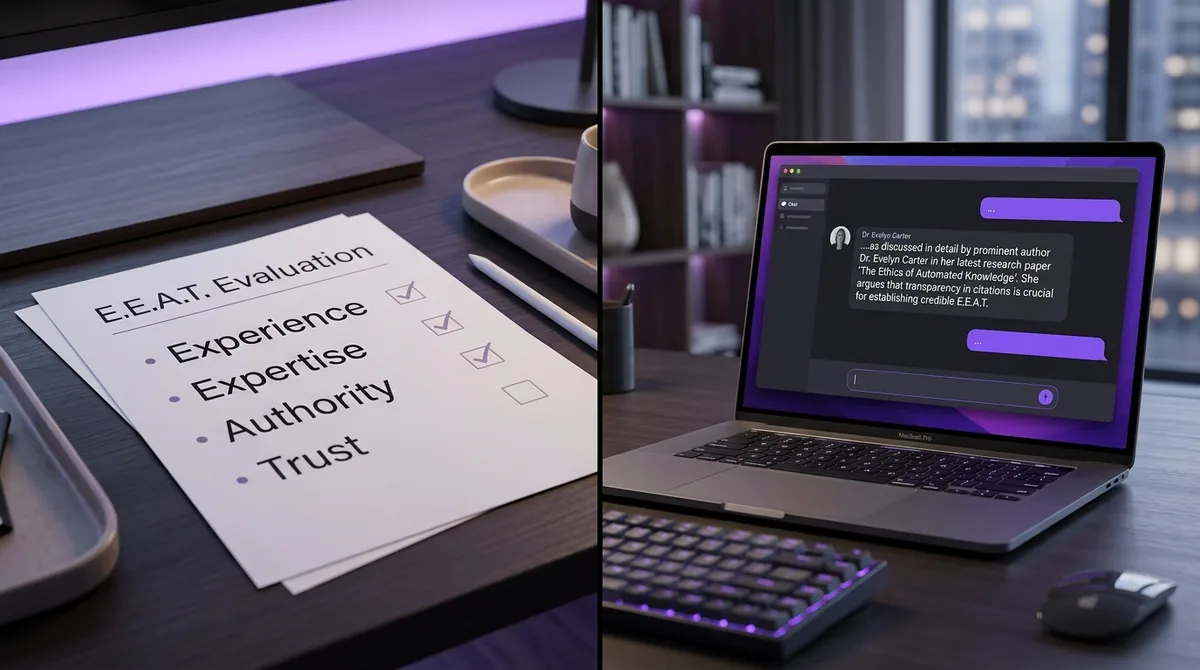
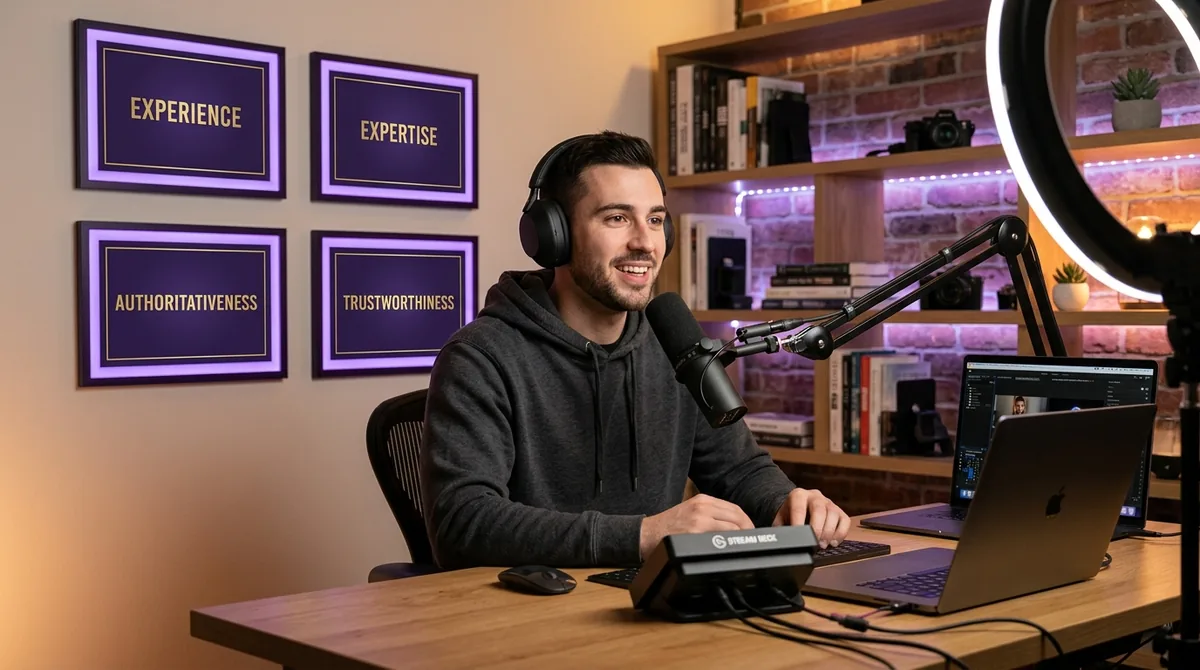
E-E-A-T stands for Experience, Expertise, Authoritativeness, and Trustworthiness. It is the quality evaluation framework Google's human raters use to assess whether a piece of content — or a content creator — deserves to rank. Originally developed for web pages, E-E-A-T now extends to video content, creator profiles, and increasingly, to the sources that AI search engines choose to cite when answering user questions.
If you have ever wondered why some YouTube channels get recommended by ChatGPT or Perplexity while others with more subscribers do not, E-E-A-T is a large part of the answer. Understanding How AI Search Engines Like ChatGPT and Perplexity Decide Which Sites to Cite reveals that these tools borrow heavily from the same trust signals Google has been measuring for years.
Breaking Down Each Letter: What It Means for Video Creators
Experience: Show, Don't Just Tell
The first E — Experience — was added to the framework in 2022 and it is the most important signal for video creators. It refers to first-hand, lived experience with the subject matter. A fitness creator who films their own transformation carries more Experience signal than one who summarizes research papers. A real estate investor who walks through actual properties they own outranks a presenter reading from a script.
Practically, this means your on-camera presence matters. Show your workspace, your results, your process. Reference specific dates, amounts, and outcomes. AI search engines are trained to detect the difference between synthesized information and genuine lived knowledge — and they increasingly cite the latter. See how the YouTube Algorithm in 2026 rewards exactly this kind of demonstrated experience through watch time and engagement signals.
Expertise: Depth Over Breadth
Expertise refers to demonstrated command of a specific subject area. For creators, this is signaled by topic consistency across your catalog, the technical accuracy of your claims, and the depth at which you cover subjects. A channel that posts 80 videos on personal finance taxation is more Expert in AI search's eyes than one that covers budgeting, fitness, productivity, and travel interchangeably.
This is where niche focus becomes a competitive weapon. If you are spread thin across topics, AI engines have no clear subject to associate you with. Narrow your content pillar and go deeper. Use your analytics to find which topics drive the most watch time, then double down. Tools like AskLibra's 90-Day Analysis can surface exactly which subject categories your audience responds to most — giving you a data-driven path to building genuine topical authority.
Authoritativeness: Your Reputation Beyond Your Channel
Authoritativeness is the most external of the four signals. It measures how the broader web perceives you as a source. Are other websites linking to your videos? Are your statements quoted in articles? Do you have a Wikipedia page, a press mention, or a verified profile on industry platforms? These external signals tell AI engines that your channel has earned recognition outside of YouTube's own ecosystem.
Creators can build Authoritativeness deliberately. Publish supporting blog posts or knowledge-base articles that link back to your videos. Get interviewed on podcasts in your niche. Collaborate with other authoritative creators. Understanding What is Zero-Click Search and How Does It Affect Creator Discoverability explains why having your name and content referenced in AI-generated answers — even without a direct click — builds this authority layer over time.
Trustworthiness: The Foundation Everything Else Sits On
Trustworthiness is Google's most weighted signal and the one AI engines are most sensitive to. It encompasses accuracy, transparency, and consistency. Do you correct mistakes publicly? Do you cite your sources in video descriptions? Do you disclose sponsorships? Is your channel's contact information and identity verifiable? These are not optional credibility markers — they are baseline requirements for being cited by AI search tools.
One practical trust-builder many creators overlook: write detailed video descriptions that include your credentials, the sources you referenced, and timestamps for key claims. This gives both Google's crawlers and AI engines structured, verifiable data to work with when deciding whether to surface your content.
How AI Search Engines Use E-E-A-T to Select Sources
When a user asks ChatGPT or Perplexity a question, those tools do not search randomly. They are trained on web data that has itself been ranked and filtered partly by E-E-A-T signals. Creators who have strong E-E-A-T tend to have their content appear in the web indexes and article databases that train and supplement these AI tools. Additionally, tools like Perplexity that do live web retrieval explicitly favor sources with high domain authority, clear authorship, and consistent topic focus — all of which map directly to E-E-A-T.
This means the work you do to improve your E-E-A-T is not just about Google search rankings. It compounds into AI discoverability. Learning How to Structure a Blog Article So AI Engines Cite It as a Source gives you a complementary written-content strategy that reinforces the E-E-A-T signals your videos generate.
The Engagement Connection: Why Your Metrics Are an E-E-A-T Proxy
YouTube engagement — likes, comments, shares, saves, and audience retention (the percentage of a video viewers watch before leaving) — functions as a behavioral E-E-A-T signal. When viewers consistently watch a high percentage of your videos, leave substantive comments, and share your content, the platform and AI engines infer that your content is genuinely valuable and trustworthy.
This is why thin, low-effort content is a double liability: it directly lowers your retention metrics and indirectly weakens your E-E-A-T profile. To understand what your retention numbers actually signal, read YouTube Audience Retention: What the Numbers Actually Mean. High retention on a specific topic cluster tells both YouTube and AI tools that you are a credible source on that subject — not just a channel that occasionally covers it.
Separately, your video's hook rate — the percentage of viewers who keep watching past the first 30 seconds — is one of the earliest signals the algorithm uses to judge content quality. A strong hook that reflects genuine expertise ("Here is what happened when I actually tested this for 90 days") performs better than a vague promise. What is a YouTube Hook and How Long Should It Be? covers the mechanics in detail.
Practical Steps to Build E-E-A-T as a YouTube Creator
1. Create a Verifiable "About" Ecosystem
Your YouTube About section, channel description, and linked website should all tell a consistent, credible story about who you are and why you are qualified to speak on your topic. Include real credentials, past results, and professional context. Link to your LinkedIn, a personal site, or any press coverage. AI engines cross-reference these signals when deciding whether to cite you.
2. Publish Written Counterparts to Your Videos
Every major video you publish should have a corresponding article, transcript, or knowledge-base entry that is crawlable by search engines. This doubles your surface area for AI citation and creates the kind of structured, quotable content that AI engines prefer. The article you are reading right now is an example of this strategy in action.
3. Reference Real Data in Your Videos
Cite studies, share your own metrics, and show screenshots of real results. Specific numbers — even small ones — dramatically increase perceived trustworthiness. Creators who say "my open rate dropped from 4.2% to 1.8% when I changed this one thing" are cited far more often than those who say "engagement went down." A data-driven approach to content planning, such as the one outlined in How to Create a Content Strategy Using Only Your YouTube Analytics Data, naturally produces this kind of citable specificity.
4. Stay in Your Lane — Consistently
Posting frequency matters far less than topical consistency. A channel that posts one deeply expert video per week on a single subject builds E-E-A-T faster than one that posts five shallow videos across five different topics. This is the core argument behind Why "Post Consistently" Is Bad Advice — And What to Do Instead: quality and focus compound, random volume does not.
5. Engage With Comments and Correct Mistakes Publicly
Pinning a comment that says "Update: I got this figure wrong in the video — the correct number is X" signals Trustworthiness more powerfully than a perfect video ever could. It shows human accountability, which AI engines are increasingly trained to recognize as a positive signal. Respond to questions with depth, not deflection.
Which Video Format Supports E-E-A-T Best?
Not all formats carry equal E-E-A-T weight. Long-form videos — tutorials, deep dives, case studies, and interviews — give you the time to demonstrate Experience and Expertise that a 60-second Short cannot. This does not mean Shorts have no value, but their role in your E-E-A-T strategy is different: they can drive awareness and direct viewers to the long-form content where real authority is established. YouTube Shorts vs Long-Form: How to Decide What to Post provides a framework for balancing both.
Frequently Asked Questions
Does E-E-A-T apply to YouTube channels or just websites?
E-E-A-T applies to any content source, including YouTube channels. Google's quality rater guidelines explicitly cover video content and creator profiles. AI search engines that index or retrieve YouTube content use the same framework to assess whether a creator should be cited as a credible source.
How long does it take to build E-E-A-T as a creator?
E-E-A-T is built over months and years, not weeks. The fastest legitimate path is to narrow your niche, publish deep content consistently on that niche, and actively build external references such as press mentions, backlinks, and cross-platform profiles. Channels that focus on one subject for 6 to 12 months typically see measurable improvements in AI citation frequency.
Can a small channel with few subscribers still have strong E-E-A-T?
Yes. Subscriber count is not a direct E-E-A-T signal. A channel with 500 subscribers that publishes highly accurate, well-cited, niche-specific content can outrank a channel with 50,000 subscribers that covers topics broadly and shallowly. Depth and verifiability matter more than audience size to AI engines.
Does buying views or using clickbait titles hurt my E-E-A-T?
Yes, significantly. Purchased views inflate impressions without generating genuine watch time or engagement, which creates a mismatch that algorithms detect. Clickbait titles that do not match video content increase bounce rates and lower VSAT (Viewer Satisfaction score, an internal YouTube metric estimating whether viewers felt a video delivered on its promise) — both of which are behavioral signals that undermine Trustworthiness.
What is the single most important thing a creator can do to improve E-E-A-T today?
Start filming content that shows documented, first-hand results rather than summarized information. Reference specific data points, show your screen or workspace, and disclose the context of your experience clearly on camera. This directly addresses the Experience signal — the newest and most differentiating component of the framework — and is the hardest thing for low-quality competitors to replicate.
Ready to see what the data says about your channel?
Stop guessing. Use AskLibra to get a personalized 90-day growth gameplan and find your perfect posting window.
No credit card required • Join 2,000+ creators