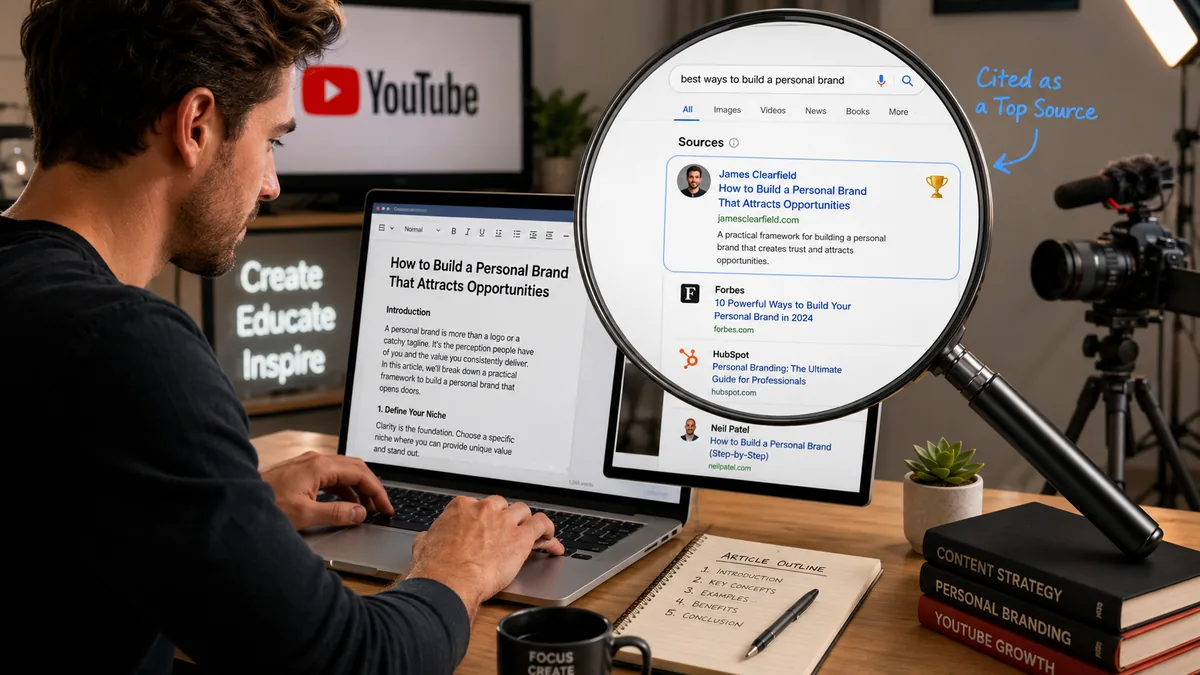


E-E-A-T in AI Search: Why It Matters More Now
Key Takeaways
- 1
E-E-A-T (Experience, Expertise, Authoritativeness, Trustworthiness) has shifted from a Google quality rubric to the primary filter AI search engines use when selecting which sources to cite.
- 2
AI tools like ChatGPT and Perplexity actively reward first-hand experience signals — personal case studies, original data, and real credentials carry more weight than ever before.
- 3
Creators and marketers who build visible authority through consistent, structured, well-attributed content are far more likely to appear in AI-generated answers than those who publish volume alone.
- 4
Practical steps like structured FAQ pages, schema markup, clear author bios, and topical depth are the fastest ways to strengthen your E-E-A-T signals for AI search.
E-E-A-T Was Always Important — AI Search Made It Non-Negotiable
E-E-A-T stands for Experience, Expertise, Authoritativeness, and Trustworthiness. Google introduced the framework in its Search Quality Rater Guidelines as a way for human reviewers to assess content quality. For years, most creators treated it as a background compliance issue — something SEO agencies worried about, not something that changed how you wrote a blog post.
That era is over.
When AI search engines like ChatGPT, Perplexity, and Google's AI Overviews generate an answer, they are not just pulling the highest-ranking page. They are synthesizing sources they consider credible, structured, and authoritative. E-E-A-T is no longer a quality signal buried in a guidelines document — it is the selection mechanism AI uses to decide whose voice gets included in an answer and whose gets ignored.
If you want to understand How AI Search Engines Rank Content — And Why It's Not the Same as Google, E-E-A-T is the most important concept to internalize first.
Breaking Down Each Letter — What It Actually Means in 2025
Experience: The Newest and Most Underrated Signal
Google added the first "E" for Experience in December 2022. It distinguishes between someone who researched a topic and someone who has lived it. An article about investing written by someone who has managed a portfolio reads differently — and signals differently — than one assembled from secondary sources.
AI search engines pick up on this distinction through specificity. First-person accounts, original screenshots, real case studies, and unique data points are hard to fake at scale. When an AI model is trained to find trustworthy content, content with concrete, verifiable experience signals gets weighted more heavily.
For creators, this means your personal results, your client outcomes, and your on-the-ground observations are assets — not just storytelling flourishes. They are credibility signals that AI tools recognize.
Expertise: Depth Over Breadth, Always
Expertise is demonstrated through depth of knowledge on a specific subject. A site that covers 400 loosely related topics signals generalist content. A site that owns a narrow topic — and covers every meaningful angle of it — signals expertise.
This is why Build Topical Authority AI Tools Will Recognize is one of the highest-leverage moves a creator can make right now. AI models are essentially asking: "Is this source the most knowledgeable voice on this specific question?" Topical depth is how you answer yes.
Expertise is also shown through vocabulary, nuance, and the absence of obvious errors. AI models have seen enough low-quality content to recognize when a piece is padding word count versus genuinely advancing understanding.
Authoritativeness: What Others Say About You
Authority is not self-declared — it is conferred. When other credible sources link to you, cite you, or reference your work, that is an authority signal. In traditional SEO, this was measured primarily through backlinks. In AI search, it extends further.
AI tools are trained on the web. If your name, your brand, or your content appears consistently across credible contexts — cited in forums, referenced in articles, quoted in newsletters — that pattern becomes part of your authority profile. This is why being cited in AI search is not just a vanity metric. To understand the mechanics, read What Is a Citation in AI Search — And How Do You Earn One?
Authority also comes from association. Publishing on recognized platforms, collaborating with known experts, and earning mentions from established media all contribute to how AI models perceive your standing in a topic space.
Trustworthiness: The Foundation Everything Else Rests On
Trustworthiness is the most foundational of the four signals. A site can have experience, expertise, and authority — but if it has broken links, no clear authorship, outdated information, or a history of misleading claims, trust collapses.
For AI search, trust signals include: clear author attribution with verifiable credentials, accurate and up-to-date factual claims, transparent sourcing, HTTPS security, and a consistent publishing identity over time. Trust is also structural — What Schema Markup Does for AI Search Visibility explains how technical signals like structured data help AI models parse and trust your content at a machine-readable level.
Why E-E-A-T Matters More in AI Search Than It Ever Did in Traditional SEO
In traditional search, a well-optimized page could outrank a more authoritative one through keyword density, link acquisition, or technical tricks. The system was gameable. AI search is harder to game because the models are evaluating content holistically — not just matching keywords to queries.
When ChatGPT or Perplexity selects a source to cite, it is essentially asking: "Would I be embarrassed if this turned out to be wrong?" That instinct maps almost perfectly onto E-E-A-T. AI tools favor sources that appear vetted, specific, well-attributed, and consistent with what other credible sources say.
The shift also means that Entity vs Keyword: Why GSO Thinks Differently — being recognized as a known entity (a real person, a real brand with a track record) matters more than keyword repetition. AI models build mental models of who the trusted voices in a space are. If you are not on that list, ranking for the right keywords will not save you.
This is also why Why Most Creators Are Invisible to AI Search (And How to Fix It) has become one of the most urgent questions for serious content producers.
What Strong E-E-A-T Looks Like in Practice
Abstract principles only go so far. Here is what strong E-E-A-T actually looks like on the page and across a site:
Named authors with real bios: Every article should have a credited author. That bio should link to a profile page that lists credentials, experience, and other published work.
Original data and primary research: Proprietary insights — your own survey results, your own platform analytics, your own case studies — are nearly impossible for AI-generated content to replicate. They are a direct experience signal.
Cited sources for factual claims: Linking out to primary research, official reports, or recognized institutions signals that you are operating in good faith and can back your claims.
Consistent publishing identity: A brand that has published thoughtful content on a topic for two years is more trustworthy than one that launched six months ago with 300 posts.
Structured content that AI can parse: Using proper heading hierarchy, FAQ sections, and schema markup helps AI models extract and attribute your content accurately. See Structure About & FAQ Pages for AI Search for a tactical breakdown.
Content that answers the actual question: AI tools cite content that directly and completely answers what a user asked. Burying the answer in a 2,000-word preamble is not a trust signal — it is friction.
The Creator Opportunity: E-E-A-T Favors Real Voices
Here is the counterintuitive opportunity inside all of this: E-E-A-T, properly understood, is one of the few frameworks that systematically advantages real human creators over AI-generated content farms.
A creator who has spent five years in a niche, who has real results to show, who has built a recognizable name — that person has genuine E-E-A-T. An AI content operation churning out generic articles does not, because it cannot demonstrate real experience, cannot build genuine authority, and cannot be trusted in the same way a known human voice can.
This is especially relevant when you consider how AI tools decide whose content to surface. As covered in How ChatGPT & Perplexity Pick Trusted Sources, these systems actively try to trace content back to verifiable, human-accountable origins. That is a structural advantage for creators who show up consistently under their own name.
For those thinking about how to position themselves for this shift, How to Win With AI in 2026: The Skill Stack Strategy lays out what this means for long-term career positioning.
The Fastest Ways to Strengthen Your E-E-A-T Right Now
You do not need to overhaul your entire content library overnight. Focus on these high-leverage moves first:
Add a detailed author bio to every published piece — include credentials, years of experience, and links to verifiable proof of work.
Publish at least one piece of original research or data-backed analysis per quarter. Even a small proprietary dataset is more valuable than ten opinion posts.
Build a tight topical cluster around your core subject area before expanding into adjacent topics.
Audit your most-visited pages for factual accuracy, broken links, and outdated claims — trust erodes fast when content ages poorly.
Add FAQ sections to your key pages. These are structured exactly how AI tools consume information. How to Write Content That AI Tools Actually Quote covers this in depth.
Implement schema markup on author pages, articles, and FAQ content. This is one of the clearest signals you can send to AI search infrastructure.
Frequently Asked Questions
What does E-E-A-T stand for?
E-E-A-T stands for Experience, Expertise, Authoritativeness, and Trustworthiness. It is a framework originally developed by Google to help quality raters evaluate whether a piece of content is credible and helpful. In the AI search era, it has become the primary lens through which AI tools assess which sources are worth citing.
Is E-E-A-T a direct Google ranking factor?
Google has clarified that E-E-A-T is not a single algorithmic ranking signal — it cannot be measured with one score. However, the signals that indicate strong E-E-A-T (backlinks, author credentials, content accuracy, structured data) absolutely influence rankings. More importantly, in AI search, the principles behind E-E-A-T directly shape which sources get cited in generated answers.
How do AI search engines use E-E-A-T differently than Google does?
Traditional Google search weighs E-E-A-T signals as part of a broader ranking algorithm. AI search engines like Perplexity and ChatGPT use similar principles to decide which sources to synthesize and surface in a generated response — but the process is more holistic. AI tools look for content that is specific, well-attributed, consistent with other credible sources, and clearly tied to a verifiable human or organization.
Can a small creator compete on E-E-A-T against large media sites?
Yes — and in some ways, a niche creator has an advantage. A creator who has deep, lived experience in a narrow topic and who publishes original insights under their own name can outrank a large media site that covers the same topic superficially. AI tools are specifically looking for the most knowledgeable, credible voice on a subject, not just the biggest brand.
How long does it take to build strong E-E-A-T?
E-E-A-T is built over time, but improvements can be felt within weeks if you act on the right signals. Adding proper author bios, fixing outdated content, implementing schema markup, and publishing original data can all produce measurable improvements in a few months. The longer-term work — building external citations and topical authority — typically takes six to twelve months of consistent effort to compound meaningfully.
Ready to see what the data says about your channel?
Stop guessing. Use AskLibra to get a personalized 90-day growth gameplan and find your perfect posting window.
No credit card required • Join 2,000+ creators