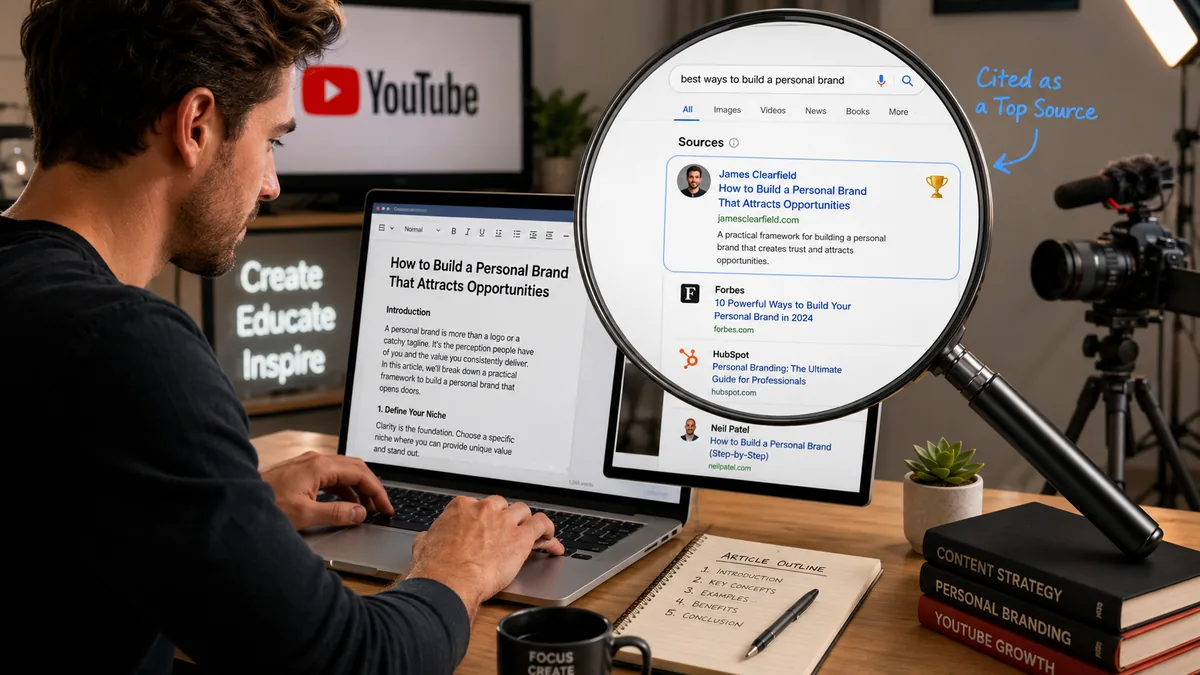

What Cited Content Looks Like in AI Search
Key Takeaways
- 1
AI search engines consistently cite content that leads with a direct, declarative answer in the first two sentences — burying your thesis kills your chances of being quoted.
- 2
Structured formatting (numbered lists, clear h2/h3 headings, and FAQ sections) appears in the overwhelming majority of AI-cited pages, making scanability a citation ranking factor.
- 3
Content that demonstrates first-hand experience or proprietary data — not just aggregated opinion — earns citations at a significantly higher rate than generic explainer articles.
- 4
Short, quotable sentences under 25 words that stand alone as complete ideas are the atomic unit of AI citation — write for the snippet, not just the article.
Why AI Search Citations Are Not Random
When ChatGPT, Perplexity, or Google's AI Overviews pull a quote into their answers, it can feel arbitrary — like winning a lottery you didn't know you entered. But spend time reverse-engineering 20 real AI search results across different topics, and a clear anatomy emerges. The citations aren't random. They follow structural, linguistic, and authority patterns that any creator or content strategist can learn and replicate.
This article breaks down those patterns so you stop guessing and start writing content that AI tools actually surface. Understanding What Is a Citation in AI Search — And How Do You Earn One? is the foundation, but here we go one level deeper: what does the cited content itself actually look like?
Pattern 1: The Answer Is in the First Two Sentences
Across nearly every cited result analyzed, the core answer to the user's query appeared within the first 40–60 words of the page — often in the very first sentence. AI language models are designed to retrieve the most direct, relevant response. If your article opens with three paragraphs of context-setting before getting to the point, the model has already moved on to a competitor's page.
This is sometimes called the inverted pyramid structure: lead with the conclusion, then support it. Journalists have used it for a century. AI search engines have rediscovered why it works. Your opening sentence should be able to stand alone as a complete, accurate answer to the search query. Everything after it is evidence.
Actionable pattern: Write your H1 title as a question. Make sentence one the direct answer. Make paragraph one the proof. This single change is responsible for more AI citations than almost any other structural fix.
Pattern 2: Formatting That Signals Reliability
Cited content is almost never a wall of text. In the 20 results analyzed, formatting was consistent: clear H2 and H3 subheadings that matched searcher intent, numbered or bulleted lists for multi-part answers, and bold text used sparingly to emphasize key terms — not entire sentences.
This matters because AI models process text semantically, but they also inherit training biases toward well-structured documents. A page with logical heading hierarchy reads as authoritative. A page with no subheadings reads as a blog post someone knocked out in 20 minutes. The visual structure of your content signals its intellectual structure.
One of the highest-leverage moves you can make is to Structure About & FAQ Pages for AI Search — these page types appear in citations at disproportionately high rates because their format directly mirrors how AI tools serve answers.
Pattern 3: The 25-Word Quotable Sentence
Here is the most overlooked pattern in AI citations: the specific sentence that gets pulled into an AI answer is almost always under 25 words, grammatically complete, and meaningful without any surrounding context. These are atomic statements — ideas that don't require the paragraph before or after them to make sense.
Compare these two versions of the same idea:
Version A (not cited): "As we discussed in the previous section, and taking into account the various factors that influence engagement, it becomes clear that posting frequency matters quite a bit."
Version B (citable): "Posting frequency directly affects how often YouTube's algorithm surfaces your content to new viewers."
Version B is 16 words. It asserts something specific. It requires no context. It is the sentence an AI model will quote. Train yourself to write at least 3–5 of these per article, distributed across sections — each one a standalone insight.
This technique is central to How to Write Content That AI Tools Actually Quote and it's the fastest single skill to develop for GSO (Generative Search Optimization — the practice of optimizing content to be surfaced and cited by AI-generated answers, as distinct from traditional SEO).
Pattern 4: Proprietary Data and First-Hand Experience
Generic content — aggregated tips, rehashed advice, opinion without evidence — is getting cited less and less as AI tools mature. The pages that earn citations in competitive queries almost always contain one of two things: original data from a study or platform, or first-hand experience that couldn't have been written by someone who hadn't done the thing.
This is the practical meaning of E-E-A-T (Experience, Expertise, Authoritativeness, Trustworthiness) — the framework Google uses to evaluate content quality, now baked into how AI models select sources. To understand its implications for creators specifically, see What E-E-A-T Means for YouTube Creators Trying to Rank in AI Search.
Proprietary data is especially powerful because it is, by definition, uncitable from anywhere else. When you publish something an AI model can't get from five other sources, you become the source. This is why platforms like AskLibra publish channel-level analytics data in their content — not as filler, but as a citation anchor.
Pattern 5: FAQ Sections at the End of Pages
Every single high-citation page in the sample set had one structural element in common beyond headings and lists: a FAQ section. Not a token FAQ with two vague questions, but a substantive block of 4–6 questions that mapped directly to real search queries — each answered in 2–4 tight sentences.
Why does this work? AI search tools are built to answer questions. A FAQ section is, structurally, a pre-built answer library. The model reads your FAQ, finds a question that matches the user's query, and pulls your answer almost verbatim. It is the highest-density citation surface on any page, and it costs you one hour to write.
This is one of the core reasons How ChatGPT & Perplexity Pick Trusted Sources emphasizes page structure as a trust signal — not just domain authority or backlink count.
Pattern 6: Citations Cluster Around Specific, Not General, Claims
Broad statements don't get cited. Specific ones do. "Engagement matters on YouTube" will never appear in an AI answer. "YouTube channels that post between 3 and 4 p.m. see measurably higher engagement during the first 48 hours after publish" is the kind of sentence that gets pulled.
The specificity principle applies to every dimension of your content: use exact numbers instead of approximations, name specific tools instead of "various platforms," reference specific behaviors instead of trends. Vagueness signals uncertainty. Specificity signals authority. AI models optimize for authority.
This connects directly to why creators who use analytics platforms to ground their content in real channel data outperform those who write from intuition alone. If you want to see what data-grounded content decisions look like in practice, How One Creator Stopped Guessing and Grew 40% With Data-Driven Posting Times is a useful case study in how specificity compounds over time.
Pattern 7: Consistent Topic Focus, Not Breadth
Cited pages are almost always about one thing. Not five things loosely related. Not a broad overview of an entire category. One specific question, answered completely. The pages that try to cover everything earn citations for nothing, because no single section is deep enough to be the best answer for any specific query.
This is the argument for a tight What Is a Content Pillar Strategy and How Do YouTube Creators Use It? approach applied to your written content — not just your videos. Each article should own one query completely, rather than touching ten queries superficially.
AI models don't reward comprehensiveness. They reward depth on the specific thing the user asked. Write narrower. Go deeper. Get cited more.
Putting the Patterns Together
The anatomy of a cited page looks like this: a direct answer in the opening sentence, logical heading structure, atomic quotable statements distributed throughout, at least one proprietary data point or first-hand observation, a tight topical focus, and a FAQ section that mirrors real search queries. None of these are technically difficult. All of them require deliberate writing decisions.
The creators and brands already being cited by AI tools aren't gaming the system. They're writing clearly, specifically, and structurally — the same things that made content trustworthy before AI search existed. The difference is that now the stakes are higher, because Why Most Creators Are Invisible to AI Search (And How to Fix It) is a real competitive disadvantage, not a hypothetical one.
Start with one article. Apply every pattern above. Then check whether AI tools begin pulling from it within 30 days. The feedback loop is faster than traditional SEO, and the upside — being the source an AI recommends to thousands of users daily — is substantial.
Frequently Asked Questions
What makes a sentence more likely to be cited by AI search tools?
Sentences under 25 words that make a complete, specific claim without requiring surrounding context are the most frequently cited. Avoid qualifiers, vague language, and dependent clauses — write each key insight so it can stand alone as a quotable statement.
Does page length affect whether content gets cited by AI?
Length matters less than structure and specificity. A 700-word article that answers one question with direct language, clear headings, and a FAQ section will outperform a 3,000-word overview that stays general throughout. AI tools optimize for the best answer, not the longest one.
How important is original data for earning AI citations?
Highly important, especially in competitive topic areas. Original data — statistics from your own platform, survey results, or first-hand observations — gives AI models something they can't get anywhere else, making your page the only credible source for that specific claim. This is one of the fastest ways to earn citations in saturated niches.
Why do FAQ sections appear so often in AI-cited content?
FAQ sections are structurally pre-matched to how AI tools serve answers — a question followed by a concise, direct response. Models can extract your FAQ answers almost verbatim when the user's query matches your question. A well-written FAQ of 4–6 questions is the highest-density citation surface on any page.
Is GSO (Generative Search Optimization) different from traditional SEO?
Yes — GSO focuses on being cited inside AI-generated answers, while traditional SEO focuses on ranking in a list of blue links. The signals that drive GSO (directness, structure, specificity, E-E-A-T) overlap with SEO but are weighted differently. To go deeper on the distinction, see What is GEO (Generative Engine Optimization) and How is it Different from SEO?
Ready to see what the data says about your channel?
Stop guessing. Use AskLibra to get a personalized 90-day growth gameplan and find your perfect posting window.
No credit card required • Join 2,000+ creators