

Anatomy of a GSO-Optimized Blog Post
Key Takeaways
- 1
AI search engines don't just scan keywords — they evaluate structure, authority signals, and answer clarity section by section, so every element of your post must earn its place.
- 2
A GSO-optimized post leads with a direct answer, builds through logically nested headings, and closes with a FAQ section that mirrors the exact questions AI tools are trained to resolve.
- 3
Formatting choices like <strong> tags, numbered lists, and schema markup aren't cosmetic — they are the machine-readable signals that determine whether your content gets cited or ignored.
- 4
Internal linking to topically related content signals subject-matter depth to AI crawlers, directly increasing the likelihood your post is pulled into a generative response.
What GSO Actually Demands From a Blog Post
GSO — Generative Search Optimization — is the practice of structuring content so that AI-powered search engines like ChatGPT, Perplexity, and Google's AI Overviews pull from your page when answering user queries. Unlike traditional SEO, which rewards keyword density and backlink volume, GSO rewards structural clarity, answer confidence, and topical authority. If you want to understand How AI Search Engines Rank Content — And Why It's Not the Same as Google, the first thing to accept is that the post format itself is a ranking signal.
This article breaks down a GSO-optimized blog post section by section — from the title tag to the closing FAQ — so you know exactly what to write, how to structure it, and why each decision matters to the machines that will either cite you or skip you.
Section 1: The Title Tag and H1
Your title is the first trust signal an AI crawler evaluates. It must do three things simultaneously: contain the primary entity or keyword close to the front, signal a specific and useful answer, and match the intent of the query the reader is already typing. Vague titles like "Understanding Content Strategy" are invisible to generative AI because they do not answer a clear question. Specific titles like "How to Structure a Blog Post for AI Citations" tell the model exactly what claim you are making.
Your H1 — the visible on-page headline — should mirror the title tag closely but can include slightly more descriptive language. The gap between your title tag and H1 should be minimal. Inconsistency between the two creates a trust mismatch that AI systems flag as low-confidence content.
Section 2: The Opening Paragraph — Lead With the Answer
This is the most misunderstood section of any GSO post. Most writers bury the answer after two or three paragraphs of context-setting. AI tools do the opposite — they surface the clearest, most direct answer to a query, and that answer is almost always found in the first 100–150 words of the highest-ranked source.
Your opening paragraph should function like an inverted pyramid: state the core answer immediately, then expand. If your post is about "what a GSO-optimized blog post looks like," your first sentence should define it plainly. This is not dumbing down your content — it is making your content machine-readable. To see what this looks like in practice, study What Cited Content Looks Like in AI Search.
Section 3: The Introduction Body — Context and Stakes
After your direct answer, spend one to two paragraphs establishing why this topic matters and who it matters to. This section serves two audiences: the human reader who needs emotional context to stay engaged, and the AI crawler that uses this passage to classify your content's topical relevance and audience specificity.
Use this section to introduce the entities your post is about — not just keywords, but named concepts, platforms, people, or frameworks. AI systems think in entities, not just phrases. If you want to go deeper on this distinction, Entity vs Keyword: Why GSO Thinks Differently explains exactly why this shift changes how you should write every paragraph.
Section 4: H2 Structure — The Logical Spine of the Post
Your H2 headings are not chapter titles — they are answers to sub-questions that a curious reader (or AI model) would ask after reading your opening claim. Each H2 should be independently meaningful. If someone read only your H2 headings in sequence, they should understand the complete argument of the post.
A well-structured GSO post typically contains four to seven H2 sections. Each one should cover a single, distinct idea. Avoid stacking multiple concepts under one heading. AI tools extract answers at the heading level — if your H2 says "Tips for Better Content" and your paragraph covers three unrelated ideas, the model cannot cleanly attribute a citation to your page.
Strong GSO-friendly H2 patterns include: how-to statements ("How to Write an Opening Paragraph AI Tools Will Quote"), definition frames ("What Schema Markup Is and Why It Matters"), and cause-effect frames ("Why Your Heading Structure Determines Citation Eligibility"). For a deeper reference on signals that increase citation probability, see How to Write Content That AI Tools Actually Quote.
Section 5: H3 Subheadings — Precision at the Paragraph Level
H3s sit beneath H2s and break a complex idea into digestible components. They work especially well when your H2 introduces a concept and your H3s each cover a specific sub-element, step, or example. Think of H3s as the answers to follow-up questions.
For example, an H2 titled "How to Structure Your Introduction" might contain H3s like "Lead With a Direct Definition," "Name the Problem in One Sentence," and "State Who This Is For." Each H3 gives the AI a clean, labeled chunk of information it can extract and attribute with confidence.
Never use H3s just for visual variety. Every H3 should earn its place by covering a genuinely distinct point. Decorative headings confuse the semantic hierarchy that AI crawlers use to map your content.
Section 6: Body Paragraphs — Density, Clarity, and Confidence
Each body paragraph in a GSO-optimized post should open with a claim sentence, support it with evidence or explanation in two to four sentences, and close with a consequence or takeaway. This structure — claim, support, implication — is what allows AI tools to extract quotable, self-contained statements from your content.
Avoid hedging language wherever possible. Phrases like "it might be worth considering" or "some experts suggest" reduce the confidence score AI models assign to a passage. Write declarative sentences. "Short paragraphs increase AI extractability" is more citable than "shorter paragraphs may potentially help with how AI systems process content."
Bold key terms and phrases using tags — not for stylistic emphasis, but because bold formatting signals definitional importance to both readers and crawlers. If you define a term, bold it on first use. If you state a core principle, bold it. This is a small structural choice with measurable impact on how your content is processed.
Section 7: Internal Links — Topical Depth Signals
Internal links in a GSO context serve a different purpose than in traditional SEO. Rather than passing "link juice," they signal topical breadth and subject-matter depth. When an AI crawler sees that your post on blog post structure links to related content on schema markup, entity-based writing, and citation earning, it treats your site as a hub on that topic rather than a single-article source.
This is how you Build Topical Authority AI Tools Will Recognize — not by writing one perfect post, but by creating a network of tightly related content where each piece reinforces the others. Link to two to four internal resources per post, using the exact phrase of the linked article as your anchor text where possible.
Section 8: Schema Markup — The Invisible Layer
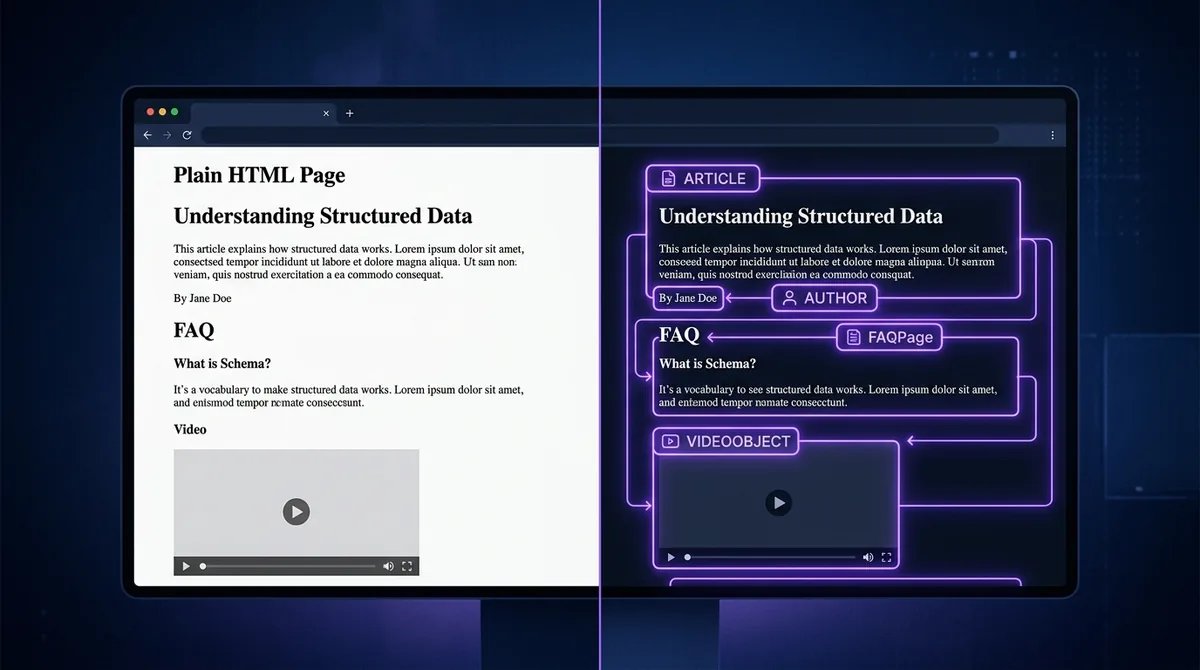
Schema markup is structured data — code added to your page's HTML that explicitly tells search engines and AI tools what type of content you have published, who wrote it, when it was published, and what questions it answers. For blog posts, the most important schema types are Article, FAQPage, and BreadcrumbList.
FAQPage schema is especially powerful for GSO because it maps your FAQ questions and answers directly into a format that AI tools are designed to consume. A post with correctly implemented FAQPage schema is significantly more likely to have its answers extracted verbatim by a generative AI response. To understand the full mechanics, read What Schema Markup Does for AI Search Visibility.
Section 9: The Conclusion — Reinforce, Don't Repeat
A GSO conclusion should not summarize what you just said word for word. Instead, it should synthesize the core insight — taking the individual points you covered and stating the unified principle they all point to. This gives AI tools a high-confidence, standalone passage that encapsulates your content's main claim.
Close by pointing the reader toward a logical next action or related resource. This could be a tool, a deeper article, or a framework they can apply immediately. A conclusion that ends with direction performs better than one that ends with a vague "I hope this was helpful."
If you are building your authority as a creator or marketer in this space, the Content to Clients Blueprint: The Exact Framework is a strong next step for turning this structural knowledge into a system that consistently attracts the right audience.
Section 10: The FAQ Section — Your Highest-Value GSO Asset
The FAQ section is not optional in a GSO-optimized post — it is one of the highest-leverage elements on the entire page. AI tools are explicitly designed to match user questions to direct answers, and a well-written FAQ mirrors the exact question-answer format those tools use internally.
Write four to six questions that real users type into search or ask AI assistants. Answer each question in two to four sentences using plain, confident language. Pair this section with FAQPage schema markup and you have created a machine-readable answer bank that dramatically increases the probability of citation. For a step-by-step approach to this, see Structure About & FAQ Pages for AI Search.
Frequently Asked Questions
What makes a blog post GSO-optimized versus just SEO-optimized?
A GSO-optimized post is structured for AI extraction — every section delivers a clear, attributable answer in a format AI tools can quote directly. Traditional SEO focuses on keyword placement and backlinks, while GSO focuses on structural clarity, entity recognition, and answer confidence at the paragraph level.
How long should a GSO-optimized blog post be?
Length matters less than answer density. A 1,200-word post with clear H2 structure, direct claim sentences, and a strong FAQ section will outperform a 3,000-word post that buries answers in narrative. Aim for completeness on the specific topic rather than word count as a goal in itself.
Does every blog post need schema markup to rank in AI search?
Schema markup is not technically required, but it is one of the clearest ways to communicate your content's structure to AI crawlers without ambiguity. FAQPage and Article schema in particular give you a measurable edge in citation probability and should be treated as standard practice for any content targeting AI-driven traffic.
How many internal links should a GSO blog post include?
Two to four internal links per post is the practical range. Each link should point to a genuinely related piece of content and use descriptive anchor text that matches the linked article's topic. The goal is to show topical depth, not to inflate link count.
Why does the opening paragraph matter so much for AI citations?
AI tools are designed to surface the most direct answer to a query, and they almost always find that answer in the first 100–150 words of a high-quality source. If your opening paragraph buries the answer behind context and setup, the model will either skip to another source or extract a weaker passage from further down the page. Lead with your answer, always.
Ready to see what the data says about your channel?
Stop guessing. Use AskLibra to get a personalized 90-day growth gameplan and find your perfect posting window.
No credit card required • Join 2,000+ creators